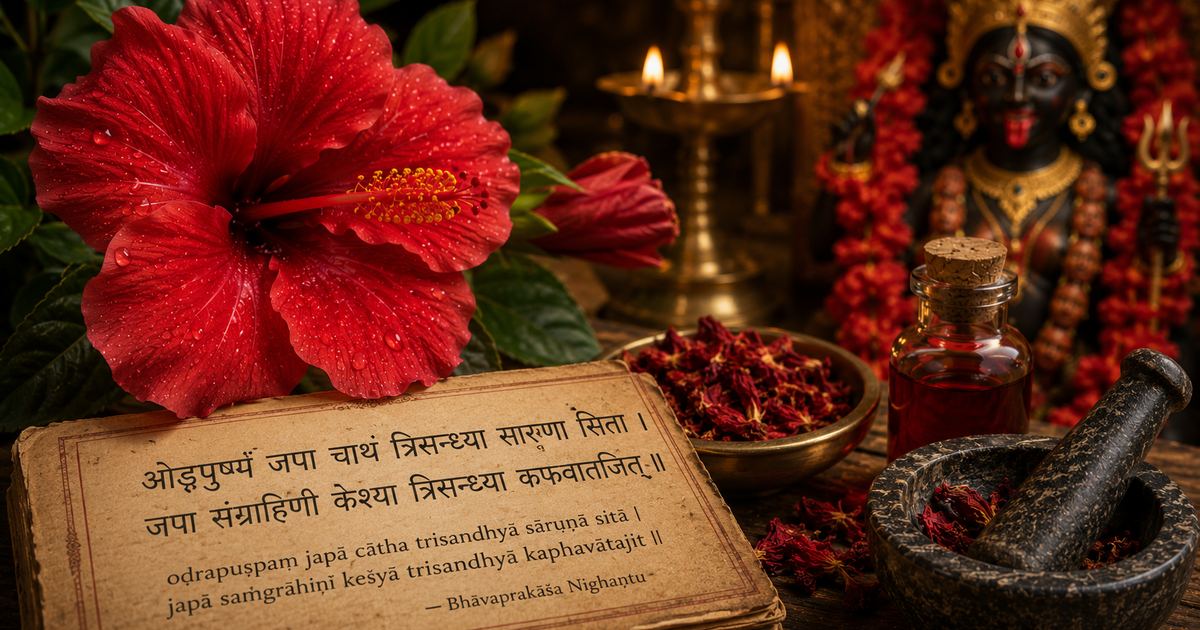
The red hibiscus occupies an unusual position in Indian life. In the physician's hands it is a hair tonic and an astringent that checks discharges; in the worshipper's hands it is the flower most beloved of Kali and Durga, laid at the feet of the fierce Mother. This essay reads the two lives of the plant together and sets them beside what modern research has found. It identifies the shrub botanically, examines how the later Ayurvedic literature describes it, considers its constituents and its modest nutritional value, reviews the pharmacological evidence for its best known actions, and notes the cautions that responsible use requires. It then turns to the devotional life of the flower, to the meaning of its redness in the worship of the Goddess, and to the stories and ideas that explain why this bloom above all others is offered to her. Sanskrit verses are given in the original with IAST transliteration and an English rendering so that the reader may weigh the sources directly.
Keywords: Japa, japākusuma, Hibiscus rosa-sinensis, gudhal, keśya, saṁgrāhiṇī, garbha-nirodhaka, Śakti, Kālī, Durgā
Introduction
Indian thought has never been comfortable keeping the body and the spirit in separate rooms. The flower a physician steeps for a hair oil is the same flower a devotee carries to the feet of the Goddess, and the tradition sees no contradiction in this. Botanically the plant is Hibiscus rosa-sinensis, known in Sanskrit as japa and its bloom as japākusuma or japāpuṣpa, and in Bengal as javā. Its many names each preserve a belief about it, whether oḍrapuṣpa, trisandhyā, aruṇā, or rudrapuṣpa. What follows traces the flower through both of its lives, the medicinal and the devotional, and tries to show why a single red bloom came to matter so much in each.
Botanical profile
Japa is Hibiscus rosa-sinensis L., a member of the mallow family Malvaceae, and one of well over two hundred species in the genus Hibiscus. The species is widely believed to have originated in tropical East or Southeast Asia, although its exact native range remains uncertain. It is a glabrous evergreen shrub, usually two to five metres tall, with smooth branches and alternate, glossy green leaves that are ovate and toothed along their margins.
Its most distinctive feature is the large, funnel-shaped flower borne singly in the upper leaf axils. From the centre of the five petals rises a long staminal column, the fused tube of stamens carrying numerous anthers and tipped by a five-branched stigma, which is the signature of the mallow family. Many cultivars now exist in a range of colours, but in both medicine and worship it is the red, or aruṇa, form that is preferred.
Japa in Ayurveda
An honest point of scholarship belongs at the start of this section. Japa does not appear in the great classical triad of Caraka, Suśruta, and Vāgbhaṭa. Its properties were recorded later, chiefly in the nighaṇṭu literature such as the Bhāvaprakāśa Nighaṇṭu and the Rāja Nighaṇṭu, and in the tradition of Puṣpa Āyurveda that deals with flowers. In the flower section of the Bhāvaprakāśa Nighaṇṭu the plant is described in a single compact verse:
ओड्रपुष्पं जपा चाथ त्रिसन्ध्या सारुणा सिता। जपा संग्राहिणी केश्या त्रिसन्ध्या कफवातजित्॥
IAST:
oḍrapuṣpaṁ japā cātha trisandhyā sāruṇā sitā, japā saṁgrāhiṇī keśyā trisandhyā kaphavātajit.
Meaning: Oḍrapuṣpa, japā, and trisandhyā are among its names, and it is found in a red form and a white one. Japa is saṁgrāhiṇī, meaning that it binds and checks discharges, and it is keśya, kind to the hair; the trisandhyā kind subdues kapha and vāta.
Later works on materia medica summarise its qualities as follows. Its taste is astringent and sweet, its quality light and slightly unctuous, and its potency is generally described as cooling in the later Ayurvedic literature. Its chief actions are keśya, the promotion and darkening of hair, saṁgrāhiṇī, the checking of excessive discharge, and garbha-nirodhaka, an action that discourages conception. On this cooling account, it is said to settle the heat of pitta and of the blood, which is why the texts mention it in conditions of heavy or irregular bleeding.
Traditional uses
The best known use of japa, and one still followed in ordinary households, is for the hair. A paste of the flowers and tender leaves, or an oil prepared with them, is applied to darken and thicken the hair, to slow its fall and its early greying, and to clear dandruff. The older texts call the flower and leaf hair-promoting and greying-preventing, and most of the herbal hair products sold in India carry some extract of japa.
Beyond this, a syrup of the flowers is taken in the hot season as a cooling and heart-pleasing drink that quiets thirst, and it is sometimes used for restlessness and poor sleep. In the disorders of women, particularly heavy bleeding, the tradition draws on the flower's cooling and binding nature. The root has been used for cough, and a paste of the flower for the healing of wounds.
Medicinal constituents and nutrition
The red of the flower comes from its anthocyanin pigments, chiefly cyanidin, which are strong antioxidants. With these the flowers and leaves carry flavonoids such as quercetin and kaempferol, along with saponins, anthraquinones, tannins, mucilage, vitamin C, and sterols such as beta-sitosterol. The flavonoids and tannins of the leaf are thought to be the likely chemical basis of its effect on hair.
On nutrition it is fair to be plain. The hibiscus flower is not a staple food in the way that the bael fruit is. It is taken in small quantities as a syrup, a tea, or a chutney, and in those forms it contributes mainly vitamin C, antioxidant pigments such as anthocyanins, and a little mucilage. It is worth adding that most of the nutritional figures that circulate under the name of hibiscus tea in fact belong to the related species Hibiscus sabdariffa, the roselle, and not to rosa-sinensis, so the two should not be confused. The real worth of japa lies less in feeding the body than in its medicinal and cosmetic virtues.
Modern scientific evidence
What is striking about the modern research is how often it supports the older description rather than unsettling it.
The clearest example concerns the hair. What Ayurveda calls keśya has been tested in the laboratory. In an experimental study by Adhirajan and colleagues, published in the Journal of Ethnopharmacology in 2003, extracts of the leaf and flower were applied to the shaved skin of rats and observed over thirty days. The treatment lengthened the growth phase of the hair follicles and increased both the length and the density of the hair, and the leaf extract proved more potent than that of the flower. Several later studies have repeated the finding, including in models of stress-induced hair loss.
A second and even firmer line of evidence concerns fertility. The nighaṇṭu tradition classes japa as garbha-nirodhaka, and this is the property that modern work has confirmed most consistently. Extracts of the flower and the root show strong anti-implantation activity, along with anti-fertility and oestrogen-like effects, in animal experiments, as reported for instance by Batta and Santhakumari in 1970 and by Pal and colleagues in Contraception in 1985. Much as the antidiarrhoeal studies of unripe bael validated its grāhi action, these findings give a clear meeting point between the old classification and the laboratory.
Beyond these, preliminary evidence suggests possible antidiabetic activity, and reviews of the plant also report antioxidant, anti-inflammatory, cardioprotective and blood-pressure-lowering, antipyretic, antimicrobial, wound-healing, and memory-supporting effects, attributed largely to its anthocyanins and flavonoids.
Two honest qualifications belong here. Most of this evidence comes from laboratory assays and animal experiments, while well-designed human trials remain few, and the extract, the dose, and the plant part vary from one study to the next. Taken together, these investigations offer a plausible biochemical account of the traditional uses, while also pointing to the need for larger clinical trials before any specific therapeutic claim can be settled.
Safety
Taken in small amounts as a syrup or a tea, the flower is generally well tolerated, and animal studies have found it free of toxicity up to fairly high doses. A few cautions still matter. The most important follows directly from the evidence above: because experimental studies repeatedly show anti-implantation and menstruation-promoting effects from the flower and root, medicinal preparations of japa should be avoided in pregnancy and by those hoping to conceive. Because preliminary evidence suggests the plant may lower blood sugar, people taking medication for diabetes should be aware of a possible additive effect, so any medicinal use is best kept under professional supervision. None of this counts against the ordinary, small-scale use of the flower as a drink; it simply marks the line between dietary use and therapeutic dosing. Any medicinal use should follow the judgement of a qualified physician.
Why the flower belongs to Kali and Durga
Here we come to the heart of the essay, the question of why this red flower became the supreme offering in the worship of Śakti, and of Kālī and Durgā in particular.
The meaning of the red
In the Śākta view the deep red of the hibiscus carries several meanings at once. It stands for blood, and so for the life force, the prāṇa that beats in every living thing, understood not as violence but as raw vitality. It is read as the energy of the rising sun, as spiritual awakening, and as the active, rajas-laden power of the Goddess who holds creation, protection, and dissolution in her hands. Where white is aligned with sattva and quietude, red belongs to rajas and to force, so that offering a red flower to the fierce Mother becomes a way of matching the quality of the flower to the nature of the deity.
So deeply did this solar redness settle into the Indian mind that even the radiance of the sun came to be described through this very flower, in the familiar morning verse of salutation:
जपाकुसुमसंकाशं काश्यपेयं महाद्युतिम्। ध्वान्तारिं सर्वपापघ्नं प्रणतोऽस्मि दिवाकरम्॥
IAST:
japā-kusuma-saṅkāśaṁ kāśyapeyaṁ mahādyutim, dhvāntāriṁ sarva-pāpaghnaṁ praṇato'smi divākaram.
Meaning: I bow to the maker of the day, the sun, glowing like the japa flower, son of Kashyapa, of great splendour, foe of darkness and destroyer of every sin. That the sun's own light is likened to the hibiscus shows how far the flower's redness had become a byword for the divine glow.
Shape and the tantric reading
In the tradition of Bengal and Odisha the shape of the flower is taken to resemble the outthrust tongue of Kālī, and for this reason a garland of one hundred and eight red hibiscus is placed upon the Goddess during Kālī Pūjā. The five petals are read as the five great elements of earth, water, fire, air, and ether, as the five faces of the Divine Mother, and as the five vital breaths, so that offering a single flower becomes a quiet surrender of one's whole elemental being to her. In tantric practice flowers are held to conduct the energy of Śakti, and in some lineages the hibiscus is treated as a flower-yantra, its centre meditated upon as the bindu, the point of origin.
A devotional story: Raktabīja and the hibiscus
A well-loved narrative ties the flower to the Goddess's slaying of Raktabīja. In the Devī Māhātmya of the Mārkaṇḍeya Purāṇa, Raktabīja is the demon from each drop of whose blood a new demon springs, so that the Goddess must drink his blood to defeat him. Folk tradition adds that from the sanctified drops of blood that fell at her feet there arose red hibiscus flowers, and that the Mother granted a boon that wherever Śakti is worshipped this flower shall be offered as her highest tribute. It should be said plainly that the slaying of Raktabīja is scriptural, while the detail of the flower's birth from his blood belongs to later devotional folklore rather than to any fixed Purāṇic verse. The meaning of the story is nonetheless a fine one, that even a negative force, touched by the Goddess, is transformed into an instrument of worship, and that grace can purify what seemed beyond redemption.
The principle beneath the offering
In the end the whole theology of offering a flower rests on a single idea, one the Gītā states in a line every worshipper knows:
पत्रं पुष्पं फलं तोयं यो मे भक्त्या प्रयच्छति। तदहं भक्त्युपहृतमश्नामि प्रयतात्मनः॥
IAST:
patraṁ puṣpaṁ phalaṁ toyaṁ yo me bhaktyā prayacchati, tad ahaṁ bhakty-upahṛtam aśnāmi prayatātmanaḥ.
Meaning: Whoever offers me with devotion a leaf, a flower, a fruit, or water, that offering of love from a pure heart I accept (Bhagavad Gītā 9.26). The worth lies in the feeling more than in the thing, and the greatness of a common, easily gathered flower like the red japa rests on exactly this primacy of devotion.
The manner of offering
Śākta worship generally prefers the red, or aruṇa, flower. In Kālī Pūjā it is customary to offer a garland of one hundred and eight blooms. The night of the new moon, and Tuesdays and Fridays, are held especially suited to the worship of Kālī. The flower should be fresh, fully open, and clean, and here as everywhere the purity of feeling is what counts. It is worth noting that the red japa is not reserved for the Goddess alone; in the south of India and in Maharashtra it is also dear to Gaṇeśa, and its redness is recalled in the worship of the sun.
Japa at a glance
| AttributeDetail | |
| Botanical name | Hibiscus rosa-sinensis L., family Malvaceae |
| Sanskrit and common names | Japā, japākusuma, oḍrapuṣpa, trisandhyā, aruṇā, javā, rudrapuṣpa, gudhal |
| Textual place | Not in the classical triad; in the Bhāvaprakāśa and Rāja Nighaṇṭus and in Puṣpa Āyurveda |
| Parts used | Flower (chiefly red), leaf, root |
| Rasa, guṇa, vīrya | Astringent and sweet; light and slightly unctuous; generally cooling potency |
| Chief actions | Keśya (hair growth and darkening), saṁgrāhiṇī, garbha-nirodhaka, kapha and vāta subduing |
| Traditional uses | Hair oils and hair care, heavy bleeding, cooling syrup, restlessness, wound healing |
| Key phytochemicals | Anthocyanins (cyanidin), flavonoids (quercetin, kaempferol), saponins, tannins, mucilage |
| Modern evidence | Hair growth, anti-implantation, possible antidiabetic, antioxidant, cardioprotective, mostly preclinical |
| Main caution | Avoid medicinal use in pregnancy and when trying to conceive; care with antidiabetic medication |
| Ritual role | Foremost flower of Kālī and Durgā; red as blood, prāṇa, and rajas; five petals as the elements |
| Special occasions | Kālī Pūjā, Durgā Pūjā, Navarātri, new-moon nights |
Closing
To hold the two lives of japa together is to glimpse the wholeness of the Indian view, in which health and reverence do not pull against each other. For the physician it is a hair-strengthening and discharge-checking herb; for the chemist a store of anthocyanins and flavonoids that support hair follicle function and may help temper blood sugar; for the Śākta worshipper it is the colour of the Mother's life force, of rajas, and of complete surrender in devotion. The same redness in which science reads an antioxidant pigment is the one in which the devotee reads the hue of prāṇa and of power, and it is this second sight that turns an ordinary garden flower into something extraordinary.
References and further reading
Classical and scriptural sources
- Bhāvaprakāśa Nighaṇṭu, Puṣpavarga, on the synonyms and properties of japā (oḍrapuṣpa).
- Rāja Nighaṇṭu and the Puṣpa Āyurveda tradition, on the medicinal uses of the flower.
- Bhagavad Gītā 9.26, "patraṁ puṣpaṁ phalaṁ toyam," on the principle of the flower offering.
- Devī Māhātmya (Mārkaṇḍeya Purāṇa), on the slaying of Raktabīja.
- The traditional solar salutation "japākusumasaṅkāśam," on the flower as a simile for the sun's radiance.
Representative modern studies
- Adhirajan N., Ravi Kumar T., Shanmugasundaram N., and Babu M., "In vivo and in vitro evaluation of hair growth potential of Hibiscus rosa-sinensis Linn.," Journal of Ethnopharmacology, 2003, 88(2-3), 235-239.
- Pal A.K., Bhattacharya K., Kabir S.N., and Pakrashi A., "Flowers of Hibiscus rosa-sinensis, a potential source of contragestive agent: possible mode of action with reference to anti-implantation effect," Contraception, 1985.
- Batta S.K. and Santhakumari G., "The anti-infertility effect of Ocimum sanctum and Hibiscus rosa-sinensis," Indian Journal of Medical Research, 1970, 59, 777-781.
- Raza H., Sultan M.T., Ahmad K., Maaz M., Zafar S., Noman A.M., and Al Jbawi E.M., "Hibiscus rosa-sinensis: A Multifunctional Flower Bridging Nutrition, Medicine, and Molecular Therapeutics," Food Science & Nutrition, 2025, 13(12), e71254, DOI: 10.1002/fsn3.71254.
Standard reference works
- Kirtikar K.R. and Basu B.D., Indian Medicinal Plants, on the description and traditional uses of Hibiscus rosa-sinensis.
- The Ayurvedic Pharmacopoeia of India, Ministry of AYUSH, Government of India, on japā.
Note: the religious significance of the flower survives in several regional and sectarian forms, and the most widely received tradition has been presented here. The account of the flower's birth from the blood of Raktabīja is devotional folklore rather than fixed scripture. Nutritional and pharmacological figures vary with species, plant part, extract, and method. Medicinal use of the plant should be undertaken only on the advice of a qualified physician.