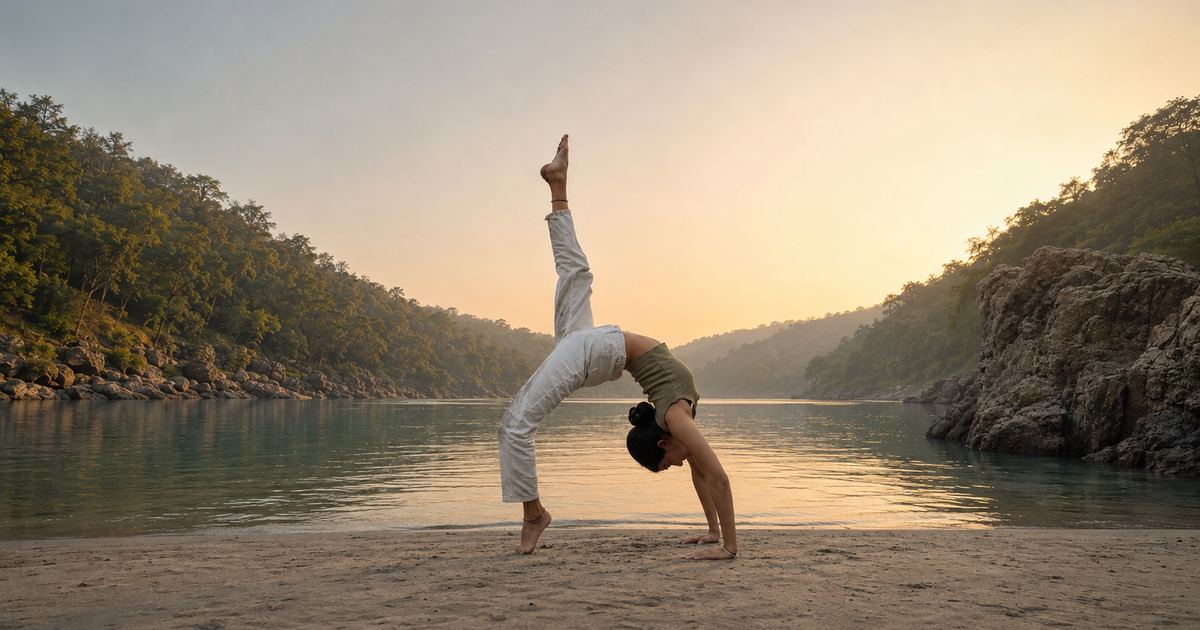
This article opens a practical series on Ashtanga Vinyasa yoga, a dynamic, breath-led method developed in the modern Mysore yoga tradition and systematised and popularised through the teaching of Sri K. Pattabhi Jois. It explains what distinguishes this style from a general yoga class, traces its lineage and the traditional account of its origins, clarifies how it relates to and differs from the eightfold path described by Patanjali, and outlines the structure a new practitioner will meet. It closes with a grounded look at what current research says about the physiological and psychological effects of the practice.
Stepping onto the mat
If you have ever walked into an Ashtanga class expecting a slow, gentle stretch, the first ten minutes probably surprised you. The room soon grows warm, the breath is audible, and bodies move in a steady rhythm that can appear almost choreographed. That impression is not wrong. Ashtanga Vinyasa is one of the most structured and physically demanding forms of yoga practised today, and once you understand its logic, that structure becomes the very thing that carries you.
I want to begin this series by clearing up what the practice is, because the word "ashtanga" causes a good deal of confusion, and a beginner deserves an honest map before the first sun salutation.
Two things that share one name
Ashtanga, meaning eight limbs, is first of all the name Patanjali gave to his eightfold path of yoga, the philosophical system explored in the companion series to this one. Ashtanga Vinyasa yoga is something different: a modern method of physical practice that borrowed that honoured name.
Sri K. Pattabhi Jois, who taught this method for most of the twentieth century, worked within this same tradition of eight limbs. Jois taught that sustained work with posture and breath could gradually open the practitioner to the wider discipline of yoga, including its ethical and contemplative limbs. So the two are not rivals. One is a map of the whole inner journey; the other is a disciplined way of setting out, starting from the most tangible place we have, the body on the mat. It helps to hold this distinction from the start, because Ashtanga Vinyasa as a set physical sequence is a twentieth-century system, not a routine described in the Yoga Sutras.
Where it comes from
The method reached the world through Pattabhi Jois (1915 to 2009), who taught from his school in Mysore, Karnataka. He learned it from his teacher, Tirumalai Krishnamacharya, one of the most influential figures in the revival of modern yoga.
The traditional account holds that the system descends from an old text called the Yoga Korunta, said to describe sequences of postures linked with breath and movement, which Krishnamacharya received from his own teacher and later transmitted to Jois. The text itself is said to be lost, and scholars have not been able to verify it independently, so it is fair to treat this as the lineage's own account of its origins rather than as settled history. What is not in doubt is that the living method, as it is practised in studios everywhere today, was shaped and standardised in Mysore in the last century.
How the practice actually works
A few features make Ashtanga Vinyasa recognisable anywhere in the world.
- Set sequences. Rather than improvising each class, practitioners work through fixed series of postures, always in the same order. The first is the Primary Series, traditionally called Yoga Chikitsa, or yoga therapy, understood within the lineage as a sequence for developing alignment, strength, mobility, and bodily purification. Beyond the Primary and Intermediate Series are four Advanced Series, traditionally designated A, B, C, and D, so the system as a whole is presented as six series, each opened to a student only when the previous one is steady.
- Vinyasa, the link of breath and movement. Vinyasa means to place in a special way. In practice it means that each movement is paired with either an inhalation or an exhalation, so the whole practice becomes one continuous, breathing motion rather than a set of separate poses. This is the beating heart of the style.
- Tristhana, three points of attention. The practice asks you to hold three things together: the posture, the breath, and a fixed gazing point called drishti. Later articles will give each of these its own treatment, because together they turn a physical workout into a moving meditation.
- Bandhas, the inner locks. Bandhas are subtle internal engagements associated with the pelvic floor and lower abdomen, called mula bandha and uddiyana bandha. In physical practice they help organise posture, breathing, and trunk control; in the traditional account, they also guide the movement of prana upward through the body.
- Mysore style. In its traditional form, students practise the memorised sequence at their own pace in a shared room, while the teacher moves among them giving individual adjustments. It looks like a group class but is really a room full of people doing their own self-practice side by side.
What it offers
Practised regularly, Ashtanga Vinyasa can develop strength, flexibility, and stamina in a way few other yoga styles do, because it asks the whole body to move continuously for an extended time. The coordination of breathing, movement, and gaze may support attentional stability and help some practitioners experience greater mental clarity after practice.
There is also a quieter benefit. Because the sequence never changes, the mind eventually stops planning what comes next and simply follows the breath. The fixed form becomes a kind of freedom. You stop managing the practice and start being carried by it.
Who it is for, and a word of caution
Ashtanga suits people who thrive on routine and are willing to show up consistently, ideally most days of the week. It rewards patience more than natural flexibility.
That said, its intensity calls for honesty about your body. If you are pregnant, recovering from injury, managing high blood pressure, or new to physical exercise, begin under the eye of an experienced teacher and let them modify the sequence for you. Ashtanga is famously demanding, and the culture around it has sometimes pushed people past sensible limits. A good practice respects pain as information, not as an obstacle to override. Start slowly, learn the breath before chasing the postures, and let depth come with time.
What the research says
Research specific to Ashtanga Vinyasa remains limited, and the honest picture is more cautious than enthusiastic. A small randomized crossover study of general vinyasa yoga found an immediate reduction in blood pressure, but its effects on heart rate and heart-rate variability were mixed, so it is not clear evidence of an autonomic benefit. An eight-week university dissertation reported improvements in reported sleep, stress, and anxiety among students practising either modified Ashtanga or slow-flow vinyasa, although depression did not improve and the two yoga styles did not differ consistently across most outcomes. A small cross-sectional imaging study also observed differences in regional glucose metabolism between experienced Ashtanga practitioners and non-practitioners, but with only a handful of participants and a cross-sectional design it cannot establish causation or show whether those differences represent a health benefit.
These findings are interesting, but larger and longer-term studies are still needed before strong claims can be made. In the articles ahead, as we look closely at the breath, the bandhas, and the sequences, I will bring in the most current and relevant studies for each, so that the practice on the mat and the evidence in the literature can be held side by side, with their limits stated honestly.
Closing
For now, it is enough to know what you are stepping into. Ashtanga Vinyasa is not a gentle drift through a few stretches. It is a structured, breath-led discipline shaped within the modern Mysore yoga tradition, connected to older yogic ideas but expressed through a distinctly modern method of physical practice, and also a surprisingly direct path to a quiet mind. In the next article we will meet tristhana, the three points of attention, which is where the real practice begins.
Roll out your mat, and we will start there.
References
Selected sources consulted for the research summary:
Blood pressure and heart rate variability responses following an acute bout of vinyasa yoga and a prolonged seated control: A randomized crossover trial. National Library of Medicine, PMC. Retrieved from https://www.ncbi.nlm.nih.gov/pmc/articles/PMC10684087/
Street, K. (2020). Effectiveness of Ashtanga and Vinyasa Yoga: Combating Anxiety, Depression, Stress and Sleep Quality. Graduate Theses and Dissertations, University of Arkansas.
Long-term Ashtanga yoga practice decreases medial temporal and brainstem glucose metabolism in relation to years of experience. EJNMMI Research (2020). Retrieved from https://ejnmmires.springeropen.com/articles/10.1186/s13550-020-00636-y
Note: Research on yoga continues to develop, and the summaries above reflect sources available at the time of writing. Later articles in this series will address the evidence for specific components of the practice in greater depth.