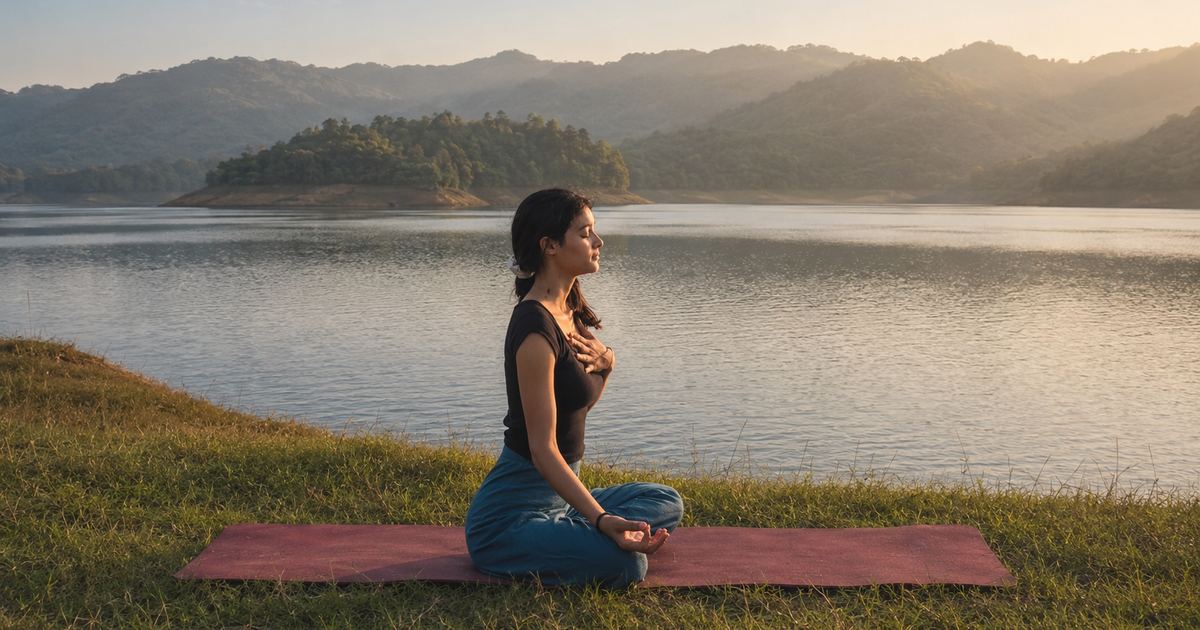
Having met the breath as one of the three points of attention, this article gives it a fuller treatment. It explains what the breath actually does in Ashtanga, why the practice is counted in breaths rather than seconds, how to build a steady breathing rhythm as a beginner, and the common mistakes that make it strained. It closes with a careful reading of the science of slow breathing, which is strong on its own terms but must be applied to a dynamic practice with real caution.
The thread that runs through everything
If you take away just one idea from this whole series, let it be this: in Ashtanga, the breath is not an accompaniment to the practice. It is the practice, and the postures are what the breath moves through.
This is a genuine reversal of how most of us first approach yoga. We tend to think of the pose as the thing, and the breath as something we ought to remember to do while holding it. Ashtanga turns that around. The breath sets the tempo, decides when you move, and tells you, moment by moment, whether the practice is going well or asking too much. Learn to trust it, and a great deal of the anxiety about getting the postures right simply falls away.
Why the practice is counted in breaths
One of the first things that surprises newcomers is that traditional Ashtanga is counted not in seconds or repetitions but in breaths. Each movement is assigned to an inhalation or an exhalation, and each posture is held for a set number of breaths. The breath, in other words, is the unit of measurement for the entire practice.
This has a quiet genius to it. A clock is external; it does not know how you feel. The breath is internal, and it carries information. When you measure your practice in breaths, you are always working at a pace your own body is setting, and the sequence stretches or compresses naturally with the state you are in that day.
This is most fully true in Mysore-style self-practice, where the practitioner follows an individual rhythm. In a traditional led class, the teacher's count provides a shared pace, and the student learns to remain steady within it.
What the breath is, and what it is not
As the previous article noted, the breath used during Ashtanga postures is commonly called ujjayi, though many teachers in the Jois lineage prefer to speak of free breathing with sound, reserving the term ujjayi pranayama for a separate, formal seated practice. The terminology differs, and the techniques are not identical in every lineage. What they share in Ashtanga practice is a nasal, continuous, audible breath that remains free from retention and unnecessary force, made long rather than deep, with inhalation and exhalation roughly equal. Depending on the teaching tradition, the soft sound may be encouraged through very gentle control around the throat and upper airway, without gripping or constricting the breath. It is never held, never forced, and never loud enough to strain.
That last point matters more than beginners expect. The aim is a breath so smooth that inhalation and exhalation are roughly equal in length and flow into each other without a catch. The sound should be a whisper you can hear, not a rasp the person three mats away can hear. If producing the sound makes your throat tight or your shoulders climb, you are working too hard at it. Let the length of the breath come first and the sound arrive on its own.
Building the breath, step by step
For someone starting out, I suggest learning the breath before layering on anything else, exactly as the first article advised.
Begin seated or standing, without any posture to worry about. Breathe in slowly through the nose, then out slowly through the nose, aiming for the two halves to feel about equal. Once that is comfortable, allow the faint throat sound to appear, softening rather than gripping. Do not chase volume. Only when this even, quiet rhythm feels natural should you bring it into movement, letting a simple sequence like a sun salutation follow the breath, one movement per inhalation or exhalation.
Expect the breath to be the first thing you lose when a posture gets difficult. That is useful information, not failure. A breath that shortens, catches, or goes silent is telling you the body has tipped past steadiness into strain. The correct response is almost always to ease the posture until the breath returns, rather than to hold the shape and abandon the breath.
Common mistakes
A few patterns show up again and again. Forcing the throat sound until the breath becomes noisy and effortful. Holding the breath unconsciously during a hard transition, which is the body bracing. Letting the inhalation grow much longer than the exhalation, or the reverse, so the rhythm becomes lopsided. And speeding the breath up to rush through a demanding stretch, which defeats the whole purpose, since the breath is meant to govern the pace, not chase it.
The remedy for all of these is the same, and it is not more effort. It is less. Soften, slow down, and let the breath lead again.
A word of caution
Breath practices are powerful, and a few situations call for care. If you are pregnant, have a respiratory condition such as asthma, have cardiovascular concerns, or feel lightheaded or anxious when you manipulate your breathing, keep the breath gentle and natural and work with an experienced teacher rather than intensifying anything on your own. Dizziness, tingling, or air hunger are signals to return to ordinary, easy breathing at once. A good breath practice should leave you calmer than it found you, never strained.
What the research says
Here the evidence is reasonably consistent for some immediate cardiovascular effects of slow breathing at rest, but less certain for emotional outcomes and long-term benefits, so let me separate the two.
The science of slow breathing at rest is one of the better-studied areas in this field. A systematic review and meta-analysis pooling thirty-one studies and over a thousand participants, though only nine of them randomized controlled trials, found that slow-paced breathing produced short-term improvements in several cardiovascular measures, including systolic blood pressure and time-domain heart-rate variability, while its pooled effect on negative emotion was more modest and did not reach conventional statistical significance. Long-term benefits are not yet established.
Several physiological mechanisms have been proposed and are supported to varying degrees. During inhalation, cardiac vagal influence generally decreases and heart rate tends to rise; during exhalation, vagal influence increases and heart rate tends to fall. Slow breathing can amplify this respiratory rhythm and may improve baroreflex sensitivity, the system that helps regulate blood pressure, and some measures of heart-rate variability. Nasal breathing is central to the traditional method, although its specific advantage over mouth breathing in this context has not been established by the evidence discussed here.
Now the caveat, which is important. Almost all of this research studies slow breathing performed at rest, often lying down, at a deliberately low rate. One small laboratory study involving twenty-five healthy young women, for instance, found lower self-reported arousal during brief slow breathing than during faster breathing in an anticipatory-threat task; the result is suggestive, but it does not establish a treatment effect for anxiety disorders. And the breath of an Ashtanga practice is a different animal altogether: it is a working breath sustained through physical exertion, faster and more effortful than resonance breathing, its job to keep you steady while the body labours. It is reasonable to think that a long, even, controlled breath helps prevent the shallow, rapid breathing that exertion and anxiety otherwise produce, and keeps the practice from tipping into a stress response. But that specific proposition, the effect of ujjayi-style breathing during a vigorous moving sequence, has not been directly tested, and it should not be assumed to deliver the same measured benefits as slow breathing at rest. As in the last article, the sensible reading is that the general physiology is reasonably supported at rest, while its application to the mat remains a plausible extension rather than a proven result.
Closing
The breath is where Ashtanga stops being exercise and starts becoming a practice you can carry anywhere, because the breath goes with you off the mat. Learn to remain with the breath, even when the posture becomes demanding, and you will have understood something essential about the heart of the method. In the next article we turn to the bandhas, the subtle internal engagements that help organise the trunk and posture and, in the traditional account, work closely with the movement of breath and prana.
Before then, on your next practice, forget the postures for a few minutes and simply follow the breath in and out. Notice how much of the practice it can carry on its own.
References
Selected sources consulted for the research summary:
The Effect of Slow-Paced Breathing on Cardiovascular and Emotion Functions: A Meta-Analysis and Systematic Review. Mindfulness (2024). Thirty-one studies, of which nine were randomized controlled trials. https://link.springer.com/article/10.1007/s12671-023-02294-2
The effect of slow breathing in regulating anxiety. Scientific Reports (2025). A small laboratory study; final sample of twenty-five healthy young women. https://www.nature.com/articles/s41598-025-92017-5
Physiology of long pranayamic breathing: neural respiratory elements may provide a mechanism that explains how slow deep breathing shifts the autonomic nervous system. Medical Hypotheses (2006). A theoretical paper proposing a physiological mechanism, not an experimental study. https://pubmed.ncbi.nlm.nih.gov/16624497/
Note: The studies above concern slow breathing performed largely at rest and do not directly test breathing during a dynamic Ashtanga sequence. Reported cardiovascular effects are mostly short-term; effects on emotion are more modest, and long-term benefits are not yet established. Research on yoga and breathwork continues to develop, and these summaries reflect sources available at the time of writing.