Stress is widely regarded as something harmful that must be eliminated. This article reframes stress as an adaptive biological signal, the body's built in alarm system, and reviews the science that explains it. Drawing on the foundational work of Cannon and Selye, the physiology of the HPA axis, the Yerkes and Dodson performance curve, and McEwen's concept of allostatic load, it distinguishes helpful short term stress from harmful chronic stress. It then examines mindset research by Crum and colleagues and by Keller and colleagues, which suggests that our beliefs about stress can shape its physical effects. The article closes with practical, evidence informed tools for regulating the stress response, clear guidance on when to seek professional help, and a complementary reflection on equanimity drawn from Indian contemplative thought. Overall, it argues that stress is best understood not as an enemy to eliminate but as a biological alarm to interpret and regulate.
Keywords: stress, alarm response, HPA axis, allostatic load, stress mindset, emotional regulation, mental wellbeing, resilience
Introduction
Picture a smoke alarm going off in your kitchen. It is loud, it is uncomfortable, and your first instinct is to make it stop. But the alarm itself is not the problem. It is doing exactly what it was built to do, which is to warn you that something needs your attention. Stress works in almost the same way. Most of us have been taught to treat it as an enemy that must be defeated, when in truth it is one of the most intelligent survival systems your body owns.
This article is not about getting rid of stress. It is about understanding what it is, why your body creates it, when it genuinely helps you, when it starts to harm you, and what the science actually says you can do about it.
What is stress, really?
In everyday language we use the word stress to mean the pressure of deadlines, exams, money, or difficult relationships. But in psychology and physiology, stress has a very specific meaning. It is the body's response to any demand placed on it, a coordinated set of physical and mental changes designed to help you meet a challenge.
The foundations of this understanding come from two pioneering scientists. In the early twentieth century, the physiologist Walter Cannon described the fight or flight response, which is the rapid mobilisation of the body when it senses a threat. Your heart rate rises, your breathing quickens, your muscles tense, and blood flow shifts to prepare you to act (Cannon, 1915).
A few decades later, the endocrinologist Hans Selye, often called the father of stress research, went further. He showed that the body responds to stressors in a predictable pattern that he called the General Adaptation Syndrome (Selye, 1956). It unfolds in three stages. First comes alarm, when the body detects the stressor and mobilises energy. Then comes resistance, when the body adapts and tries to cope while the stressor continues. Finally, if the stress goes on for too long, comes exhaustion, when the body's resources run down and damage begins.
Notice the word Selye himself chose for that first stage. He called it alarm. Stress, at its very origin, is a signal, not a malfunction.
The chemistry behind the feeling
When you face a challenge, a small region of your brain called the hypothalamus sets off a rapid chain reaction. It activates the sympathetic nervous system and the HPA axis, short for the hypothalamic, pituitary and adrenal axis, resulting in the release of catecholamines such as adrenaline and glucocorticoids, primarily cortisol.
Adrenaline produces the immediate surge you feel, the racing heart, the sudden alertness, the burst of energy. Cortisol, often called the stress hormone, keeps the body mobilised and manages your energy over a longer period.
In short bursts, this is brilliant design. Cortisol sharpens your focus, releases stored energy, and can even strengthen some functions for a while. The problem is not that these chemicals exist. The problem begins only when the alarm never switches off.
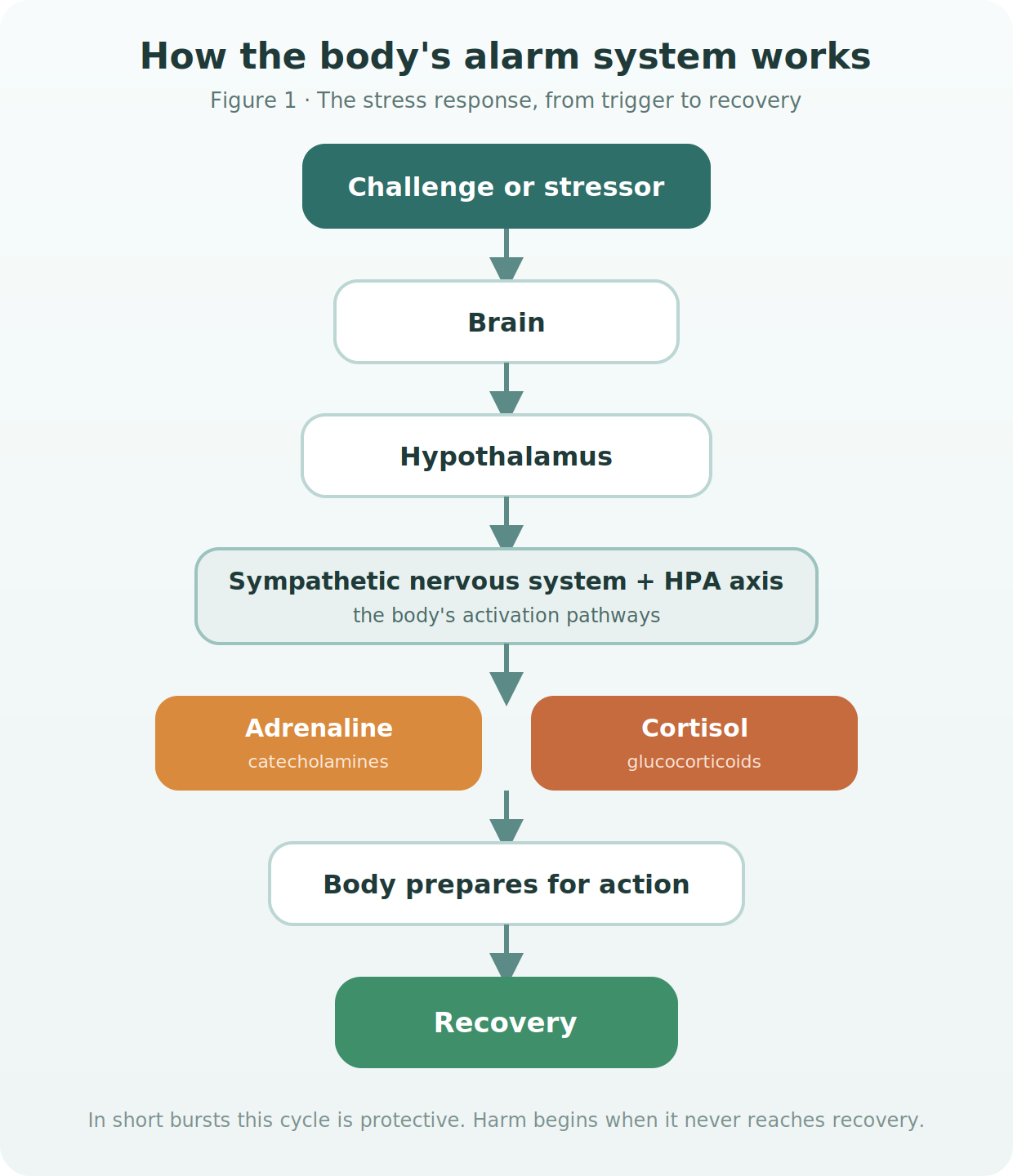
Figure 1. How the body's alarm system works. In short bursts this cycle is protective; harm begins only when it never reaches recovery.
When stress actually helps you
Here is something most people are never told. A moderate amount of stress can make you perform better.
One of the oldest and most cited findings in all of psychology is the Yerkes and Dodson law, first described in 1908. It shows that performance improves as pressure or arousal increases, but only up to a point (Yerkes & Dodson, 1908). Drawn on a graph, the relationship looks like an upside down U. With too little pressure we feel flat, bored and unmotivated. With the right amount of pressure our attention sharpens and our performance rises. With too much pressure, performance falls apart.
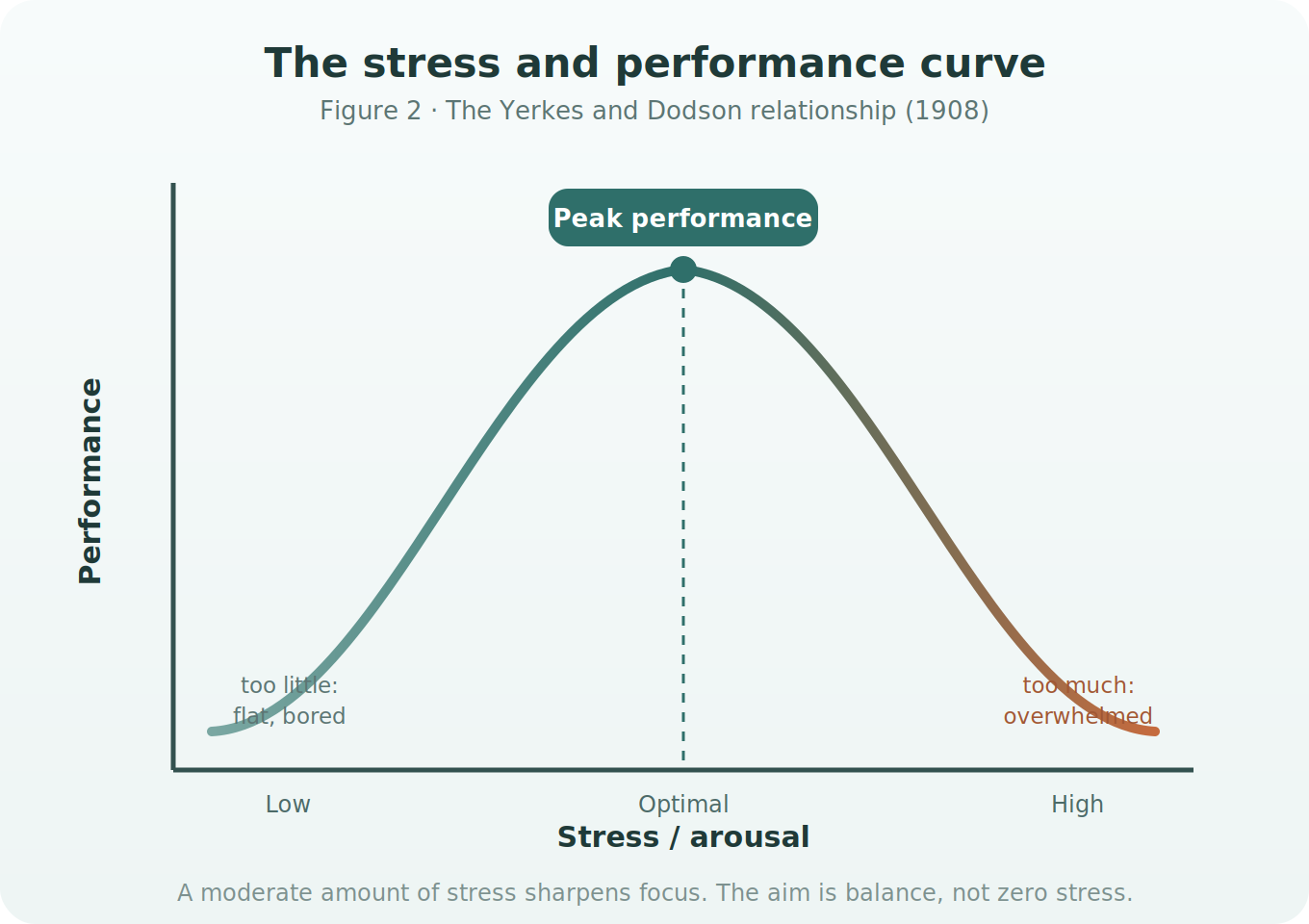
Figure 2. The stress and performance curve (Yerkes and Dodson, 1908). A moderate amount of stress sharpens focus; the aim is balance, not zero stress.
This is why a student often does their sharpest revision in the week before an exam. It is why athletes talk about needing their nerves before a big match. It is why a looming deadline can suddenly make the mind feel clear. That flutter in your stomach before something important is not a sign that you are weak. It is your body preparing you to rise to the occasion.
The goal, then, is not a life with zero stress. The goal is to find your place near the top of that curve.
When the alarm becomes the danger
If short bursts of stress are protective, why does stress carry such a bad reputation? The answer lies in what happens when it becomes chronic, when the body stays in a state of alarm for weeks, months or even years without real recovery.
The neuroscientist Bruce McEwen gave us a useful idea for this, which he called allostatic load. It refers to the cumulative wear and tear on the body caused by repeated or prolonged stress responses (McEwen, 1998). When the alarm keeps ringing without pause, the same chemicals that once protected you begin to erode your health, contributing to poor sleep, a weakened immune system, high blood pressure, anxiety and low mood.
The biologist Robert Sapolsky captured this idea in the title of his well known book, Why Zebras Don't Get Ulcers (Sapolsky, 2004). A zebra feels intense stress when a lion chases it, but the moment the danger passes, its body returns to calm. Human beings are different. We can switch on the very same stress response simply by thinking about a difficult meeting, an unpaid bill, or an argument from last week. In a sense we are being chased by lions that live only in our minds, and our bodies pay the price for a threat that never actually arrives.
So the danger was never stress itself. The real danger is stress that has no off switch.
The most surprising finding of all
Now we arrive at the very heart of why this article carries the title it does.
In a landmark study published in the Journal of Personality and Social Psychology, the psychologist Alia Crum and her colleagues showed that a person's beliefs about stress, what researchers call their stress mindset, actually shaped how their body responded to it (Crum, Salovey, & Achor, 2013). Participants who were guided to see stress as something that could enhance and energise them, rather than something that damaged them, showed healthier patterns of cortisol response and performed better under pressure.
An even more striking result came from a large study led by Abiola Keller and colleagues, which followed a nationally representative sample of adults over several years (Keller et al., 2012). The researchers found that a high level of stress was linked to a greater risk of dying, but mainly among people who also believed that stress was harmful to their health. In fact, those who reported high stress and believed it was seriously harming them had about a forty three percent higher risk of premature death, while people who lived with high stress yet did not view it as damaging showed no such increased risk. The psychologist Kelly McGonigal later carried this research to a wide audience, arguing that the way we think about stress may matter almost as much as the stress itself (McGonigal, 2015).
Read that slowly, because it is one of the most important ideas in modern health psychology. The way you interpret your stress response can shape the effect it has on your body and your mind. Treat that pounding heart as proof that you are falling apart, and your body braces itself defensively. Treat it as your body delivering energy to help you meet the moment, and the very same sensation becomes fuel.
A word of balance is important here. A healthy stress mindset does not erase the biological effects of prolonged stress, nor does it replace practical problem solving or professional care. What it does is influence how we interpret and respond to stressful situations, and that influence is meaningful.
This is exactly why we should not make stress our enemy. An enemy is something we fear. An alarm is something we can learn to read.
What you can actually do, starting today
Understanding is powerful, but you also deserve practical tools. Here are four of them, each grounded in the science above.
The first is to reframe the sensation. The next time your heart races before something important, try naming it differently. Instead of thinking I am so anxious, tell yourself my body is getting me ready. This is not empty positivity. It is the mindset research applied directly. You are not denying the feeling. You are simply reading it correctly.
The second is to give the alarm an off switch through your breath. The fastest way to signal safety to your nervous system is slow breathing, which is associated with increased parasympathetic activity, the body's rest and recovery mode, partly mediated through vagal pathways. Try this. Breathe in gently through your nose for a count of four, then breathe out slowly through your mouth for a count of six, and repeat for about two minutes. The key is to make the out breath longer than the in breath, because it is the exhale that truly calms the body.
The third is to complete the stress cycle. A zebra shakes off the chase and moves on, while we humans tend to stay frozen at our desks. Physical movement, whether a brisk walk, some stretching, or even shaking out your hands, helps your body burn through the stress chemicals and settle back to normal. Stress is a physical event, so it often needs a physical release.
The fourth is to protect your recovery, not only your effort. Allostatic load builds up when there is no rest between demands. Guard your sleep, take genuine breaks, and treat recovery as part of the work rather than a reward you earn only after finishing it.
When to seek professional support
Stress becomes a concern that deserves professional attention when it lingers for weeks and does not ease even during rest or time away. It also deserves attention when it disrupts your sleep, appetite, concentration or relationships, when you feel constantly on edge and unable to switch off, when you find yourself leaning on unhealthy ways of coping just to get through the day, or when you feel hopeless or notice any thoughts of harming yourself.
If any of this feels familiar, and especially if you have thoughts of harming yourself, please reach out to a mental health professional or a helpline in your area without waiting. Asking for help is not a sign of weakness. It is one of the most intelligent responses a person can have to an alarm that has been ringing for too long.
Stress will always be part of a full, ambitious and caring life. The aim is not to silence the alarm forever. The aim is to learn to listen to it, so you know when it is helping you rise and when it is quietly asking you to rest.
The SADHNAM Perspective
Stress is not merely a biological response. It is also an invitation to become aware of how the mind reacts to the events of life. Alongside evidence based psychology, gentle practices such as mindful breathing, meditation, honest self observation and compassionate living may support emotional wellbeing and help us meet the alarm with steadiness rather than fear. At SADHNAM we see these practices as a way to know one's own mind more clearly. They are meant to complement, and never to replace, professional mental health care when it is needed.
A reflection from the Bhagavad Gita
"Yogasthah kuru karmani" (Bhagavad Gita 2.48) This line is often interpreted as an invitation to act while remaining steady within. It belongs to a spiritual and philosophical tradition rather than to psychological science, and it does not prove any modern theory. Yet its emphasis on equanimity in the face of success and failure offers a complementary perspective that resonates with contemporary ideas about emotional regulation and a balanced relationship with stress. Rather than presenting scripture as scientific evidence, we offer it here as a philosophical reflection that may enrich personal understanding.
A Moment of Practice
The two minute SADHNAM exercise. A short practice you will find at the close of every article in this series.
- Close your eyes.
- Notice your breathing, just as it is.
- Do not fight the stress.
- Simply ask yourself: "What is this alarm trying to tell me?"
- Observe the answer without judgement.
- Take six slow breaths, letting each out breath be a little longer than the breath in.
- Gently open your eyes.
This is not only a relaxation technique. It is a small act of listening to your own mind, which is where every kind of self understanding begins.
Practical takeaways
Key Messages
- Stress is adaptive. It is your body's alarm, not a fault or a weakness.
- Recovery is essential. What harms the body is stress with no rest.
- Interpretation matters. How you read the stress response shapes its effect.
- Chronic stress deserves attention, not avoidance.
- Professional support is a strength, not a weakness.
For everyday practice, remember the four simple tools from this article: reframe the feeling as readiness, breathe with an exhale longer than the inhale, move your body to release the tension, and protect your recovery as seriously as your effort. And seek professional help if stress lingers for weeks, disrupts daily life, or brings hopelessness or any thoughts of self harm.
Questions for reflection
Take a quiet moment with these. They are meant not to test you but to help you know your own mind a little better.
- What situations trigger stress most often in my life?
- How does my body usually respond to stress?
- Which of the strategies in this article can I practise this week?
- What helps me truly recover after a demanding day?
References
Cannon, W. B. (1915). Bodily changes in pain, hunger, fear and rage. D. Appleton & Company.
Crum, A. J., Salovey, P., & Achor, S. (2013). Rethinking stress: The role of mindsets in determining the stress response. Journal of Personality and Social Psychology, 104(4), 716–733. https://doi.org/10.1037/a0031201
Keller, A., Litzelman, K., Wisk, L. E., Maddox, T., Cheng, E. R., Creswell, P. D., & Witt, W. P. (2012). Does the perception that stress affects health matter? The association with health and mortality. Health Psychology, 31(5), 677–684. https://doi.org/10.1037/a0026743
McEwen, B. S. (1998). Protective and damaging effects of stress mediators. New England Journal of Medicine, 338(3), 171–179. https://doi.org/10.1056/NEJM199801153380307
McGonigal, K. (2015). The upside of stress: Why stress is good for you, and how to get good at it. Avery.
Sapolsky, R. M. (2004). Why zebras don't get ulcers (3rd ed.). Henry Holt and Company.
Selye, H. (1956). The stress of life. McGraw-Hill.
Yerkes, R. M., & Dodson, J. D. (1908). The relation of strength of stimulus to rapidity of habit-formation. Journal of Comparative Neurology and Psychology, 18(5), 459–482. https://doi.org/10.1002/cne.920180503
Further reading
For readers who wish to explore stress and mental wellbeing through trusted public health sources:
- American Psychological Association, Stress resources. https://www.apa.org/topics/stress
- World Health Organization, Stress. https://www.who.int/news-room/questions-and-answers/item/stress
- National Institute of Mental Health, Caring for your mental health. https://www.nimh.nih.gov
Disclaimer
This article is intended for general educational purposes only. It does not constitute a diagnosis, treatment, or a substitute for professional medical or psychological advice. If stress or any related concern is affecting your daily life, please consult a qualified mental health professional. For personal guidance shaped around your own situation, you can book a consultation through SADHNAM.
If you are experiencing persistent distress, panic attacks, severe depression, or any thoughts of harming yourself, please seek immediate support from a qualified mental health professional or your local emergency services. You do not have to face it alone.