
We often speak of qualities like discipline, confidence or willpower as though they were fixed traits, things a person either has or lacks. Yet a large body of psychological research suggests that personal growth is far less about innate character and far more about small, repeatable practices that anyone can learn. This article looks at the science of personal growth and self development, drawing on the work of Lally and colleagues on how habits actually form, Neff on self compassion, Kabat-Zinn on mindfulness, Emmons and McCullough on gratitude, and Locke and Latham together with Gollwitzer on setting goals that stick. It explains why change is usually gradual, why kindness toward oneself supports growth better than harsh criticism, and how simple, evidence based practices can steadily reshape a life. Overall, it argues that we are not finished products but works in progress, and that this is not a burden but a quietly hopeful truth.
Keywords: personal growth, self development, habits, self compassion, mindfulness, gratitude, goal setting, behaviour change, wellbeing
Introduction
There is a tempting way of thinking about ourselves that divides people into those who simply have it, the discipline, the confidence, the calm, and those who do not. In this view, growth is a matter of character we were either born with or missed out on. It is a discouraging story, and happily it is not the one the research tells.
The science of self development points to something far more hopeful. Growth is less like flipping a switch and more like tending a garden. It happens gradually, through small and repeatable practices, and almost anyone can learn the skills involved. This article gathers a few of the most useful of those practices, each grounded in research, so that becoming a little more like the person you want to be feels less like a mystery and more like something you can actually do.
How habits actually form
So much of who we are is simply what we do repeatedly. This is why habits sit at the heart of self development, and why understanding how they really form matters so much.
A well known study by Phillippa Lally and her colleagues followed people as they tried to build a new daily habit, and the findings gently dismantle a popular myth. Forming a habit did not take a tidy twenty one days. In that study the average was about sixty six days for a behaviour to become automatic, with wide individual variation, ranging from around eighteen days to well over two hundred (Lally et al., 2010). Just as importantly, missing a single day did not undo the progress. The habit continued to form regardless.
Two lessons follow. First, if a new habit feels effortful for weeks, that is not a sign of failure but exactly what the science predicts. Second, one slip does not ruin anything, so the kindest and most effective response to a missed day is simply to continue the next.
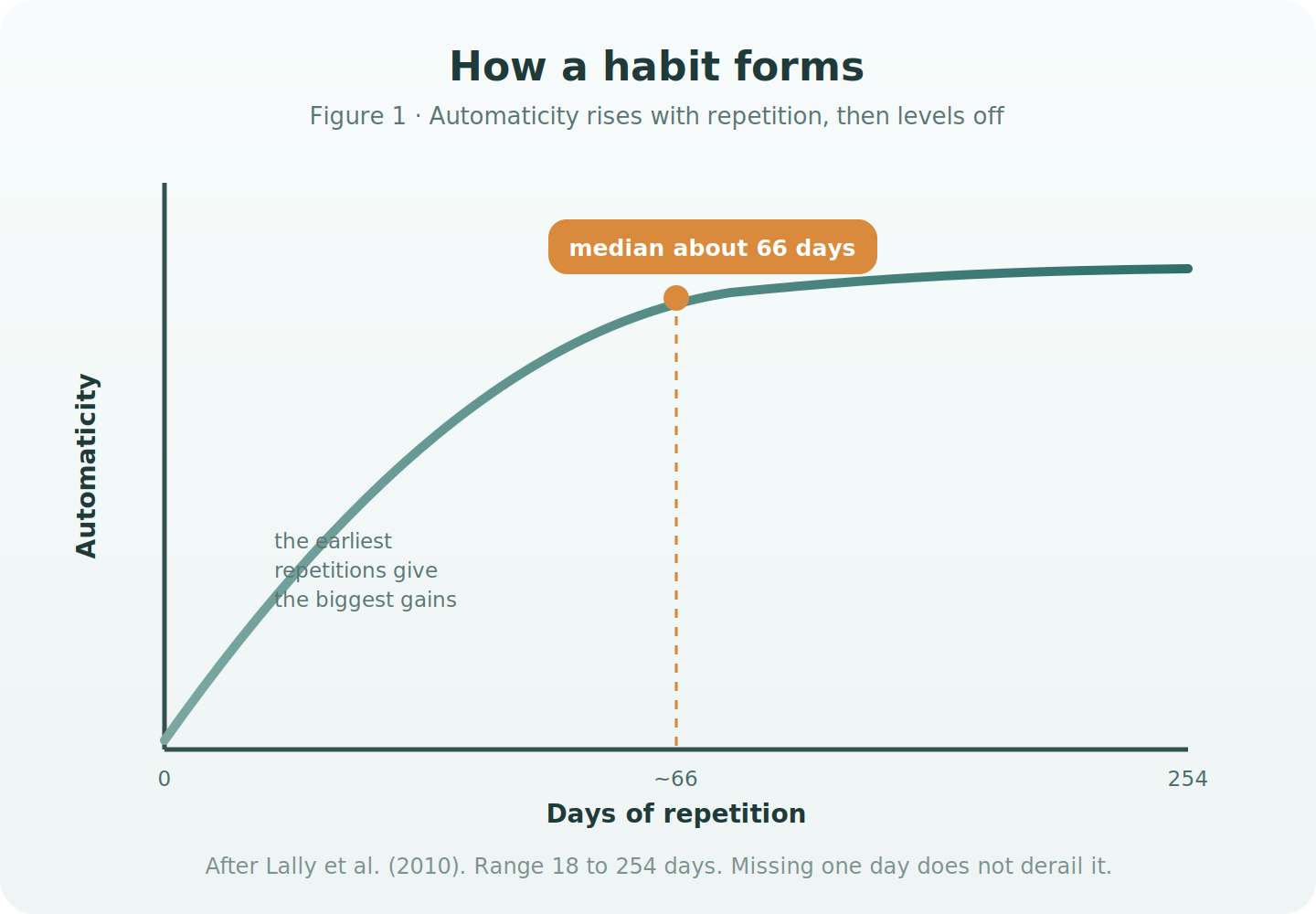
Figure 1. How a habit forms. Early repetitions give the biggest gains, and consistency matters more than perfection.
Be kind to the one doing the growing
Many of us believe that the way to improve is to be hard on ourselves, as though self criticism were the engine of change. The research suggests almost the opposite.
The psychologist Kristin Neff has studied self compassion, which means treating yourself in moments of failure or difficulty with the same kindness you would offer a good friend. Her work found that self compassion is linked to less anxiety and depression and to greater life satisfaction, and that it tends to be a steadier foundation than self esteem, which often rises and falls with success and comparison (Neff, 2003). Harsh self criticism, far from motivating us, tends to leave us discouraged and stuck. Being gentle with yourself is not letting yourself off the hook. It is what allows you to get back up and keep going.
Mindfulness: the skill of paying attention
Much of life runs on autopilot, and so do many of the habits we would rather change. Mindfulness is the simple but powerful skill of noticing the present moment, including our own thoughts and feelings, with openness and without judgement.
Popularised in a clinical context by Jon Kabat-Zinn, mindfulness practice trains the mind to observe what is happening rather than to be swept along by it (Kabat-Zinn, 1990). This matters for growth because we cannot change what we do not notice. A moment of awareness, catching an urge before we act on it, or a harsh thought before we believe it, is often the small gap in which real change becomes possible.
Gratitude: a small practice with real effects
Some of the most studied self development practices are also the simplest. Gratitude is a fine example. In a well known experiment, people who regularly wrote down a few things they were grateful for, rather than their hassles, reported greater wellbeing, more positive mood, and in some cases even better sleep (Emmons & McCullough, 2003).
The point is not to deny life's difficulties or to force cheerfulness. It is that deliberately noticing what is good, something our minds do not do automatically, gently shifts the balance of our attention over time. A few minutes of genuine gratitude, practised regularly, is a small investment with a surprisingly real return.
Setting goals that actually work
Growth often needs direction, and here too the research offers practical guidance. Decades of study by Edwin Locke and Gary Latham found that specific and suitably challenging goals lead to better results than vague encouragements such as trying to do your best (Locke & Latham, 2002). A goal like walking for twenty minutes after dinner is far more powerful than a wish to get fitter.
Knowing what to do, however, is not the same as doing it. This is where a simple technique studied by Peter Gollwitzer comes in. Forming what he called an implementation intention, a plan in the shape of when situation X happens, I will do Y, sharply increases the chance that we follow through (Gollwitzer, 1999). Deciding in advance that after I pour my morning tea, I will write for ten minutes links the new behaviour to an existing cue, so it no longer depends on remembering or on willpower in the moment.
A small example shows the difference. A vague goal such as I will read more tends to fade, because it names no action, time or place. A specific goal with a built in cue, such as after dinner, I will read ten pages at my desk, is far easier to act on, because the moment itself becomes the reminder.
Brain Insight: A repeated behaviour becomes easier when it is linked to a stable cue. The aim is not to summon stronger willpower every single day, but to build a more reliable environment that carries the behaviour for you.
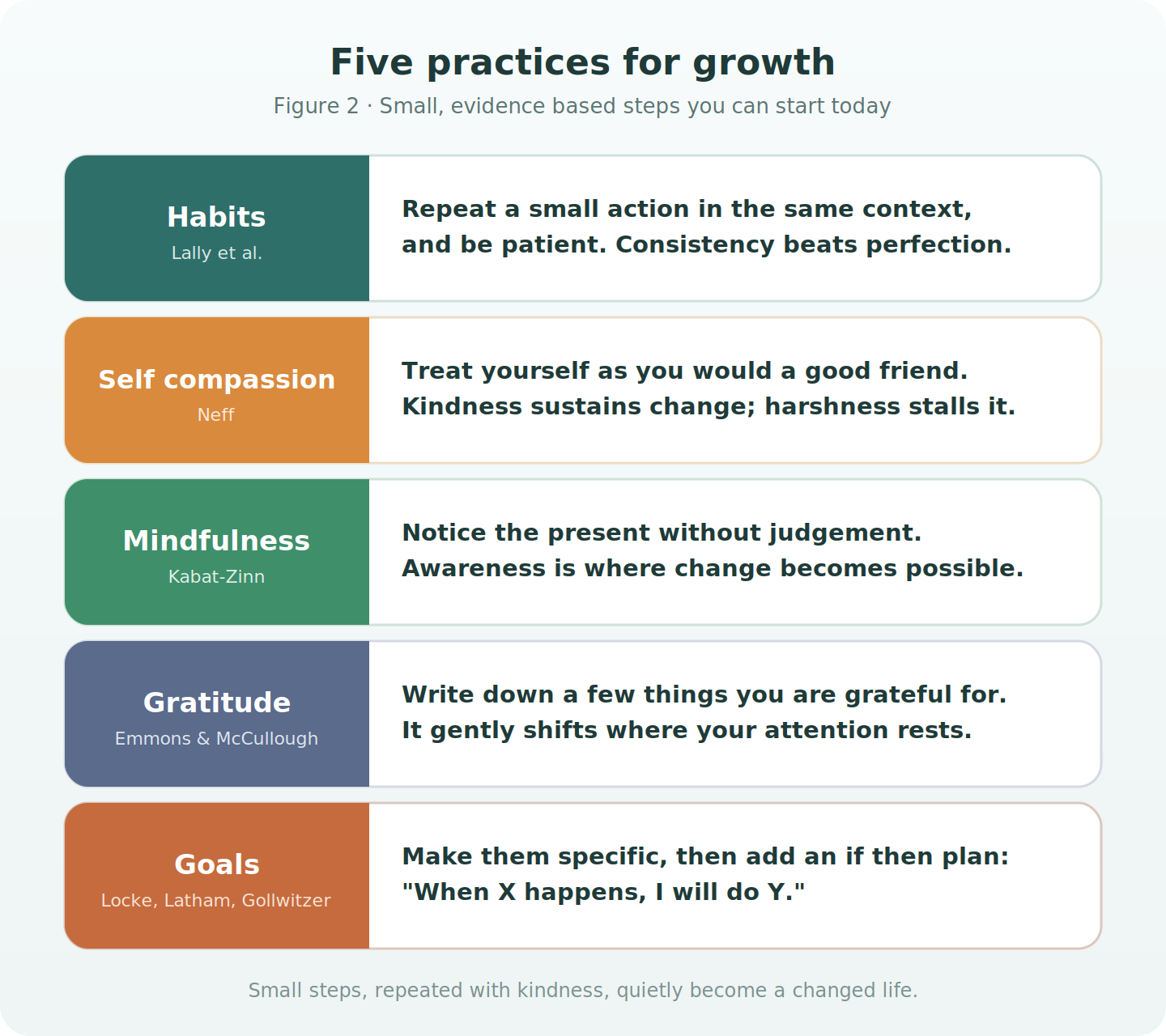
Figure 2. Five evidence based practices for growth, drawn from this article.
When to seek professional support
Self development practices are powerful, but they are not a replacement for care when it is needed. It is worth reaching out to a qualified professional if low mood, anxiety or harsh self criticism persist and weigh on you no matter what you try, if you feel stuck or overwhelmed for weeks at a time, if the drive to improve tips into never feeling good enough, or whenever you have any thoughts of harming yourself. Growth and healing can go hand in hand, and asking for support is itself a form of self development.
The SADHNAM Perspective
At the heart of self development lies a relationship, the one we have with ourselves. Alongside evidence based practices, gentle habits such as mindful awareness, honest self reflection, gratitude and self compassion can help us become both the gardener and the garden, tending our inner life with patience rather than force. At SADHNAM we see growth not as a race toward some finished version of ourselves, but as a steady, kind unfolding. These practices are meant to complement, and never to replace, professional support where it is needed.
A reflection from the Bhagavad Gita
उद्धरेदात्मनात्मानं · Uddhared ātmanātmānaṁ (Bhagavad Gita 6.5) This line is often interpreted to mean that a person should lift themselves up by their own effort, and that the self can be its own greatest friend. It belongs to a spiritual and philosophical tradition rather than to psychological science, and it does not prove any modern theory. Yet its emphasis on becoming a friend to oneself, and on our own quiet agency in growth, resonates gently with what research tells us about self compassion and steady effort. Rather than presenting scripture as scientific evidence, we offer it here as a philosophical reflection that may enrich personal understanding.
A Moment of Practice
The two minute SADHNAM exercise. A short practice you will find at the close of every article in this series. This week, a brief reflective meditation.
- Sit comfortably and take a few slow breaths, letting your shoulders soften.
- Bring to mind one small step you have taken recently toward the person you would like to be, however tiny it may seem.
- Rather than measuring how far you still have to go, simply acknowledge that you moved at all.
- Silently offer yourself one honest, encouraging phrase, such as: I am growing, and that is enough for today.
- Rest for a few breaths in that quiet sense of progress before you open your eyes.
This is not about grand transformation. It is about noticing and honouring the small movements that, repeated over time, quietly become a changed life.
Key messages
Key Messages
- Growth is built through small, repeatable practices, not fixed traits.
- Habits take time to form, often longer than expected, and one missed day does not undo them.
- Self compassion supports lasting change better than harsh self criticism.
- Mindfulness creates the moment of awareness in which change becomes possible.
- Gratitude and specific, well planned goals are simple practices with real effects.
- You are a work in progress, and steady, kind effort is what moves you forward.
Questions for reflection
Take a quiet moment with these. They are meant not to test you but to help you grow with a little more kindness.
- What is one small habit I would like to build, and to what daily cue could I attach it?
- How do I usually speak to myself when I fall short, and how might I speak more kindly?
- What are three things, however small, that I feel grateful for today?
- What is one specific goal I care about, and what is my if then plan for acting on it?
References
Emmons, R. A., & McCullough, M. E. (2003). Counting blessings versus burdens: An experimental investigation of gratitude and subjective well-being in daily life. Journal of Personality and Social Psychology, 84(2), 377–389. https://doi.org/10.1037/0022-3514.84.2.377
Gollwitzer, P. M. (1999). Implementation intentions: Strong effects of simple plans. American Psychologist, 54(7), 493–503. https://doi.org/10.1037/0003-066X.54.7.493
Kabat-Zinn, J. (1990). Full catastrophe living: Using the wisdom of your body and mind to face stress, pain, and illness. Delacorte Press.
Lally, P., van Jaarsveld, C. H. M., Potts, H. W. W., & Wardle, J. (2010). How are habits formed: Modelling habit formation in the real world. European Journal of Social Psychology, 40(6), 998–1009. https://doi.org/10.1002/ejsp.674
Locke, E. A., & Latham, G. P. (2002). Building a practically useful theory of goal setting and task motivation: A 35-year odyssey. American Psychologist, 57(9), 705–717. https://doi.org/10.1037/0003-066X.57.9.705
Neff, K. D. (2003). The development and validation of a scale to measure self-compassion. Self and Identity, 2(3), 223–250. https://doi.org/10.1080/15298860309027
Further reading
For readers who wish to explore self development through trusted sources:
- Greater Good Science Center, University of California, Berkeley. https://greatergood.berkeley.edu
- Self-Compassion, research and practices by Kristin Neff. https://self-compassion.org
- American Psychological Association, Psychology topics. https://www.apa.org/topics
Disclaimer
This article is intended for general educational purposes only. It does not constitute a diagnosis, treatment, or a substitute for professional medical or psychological advice. If you are struggling with your mental health, please consult a qualified professional. For personal guidance shaped around your own situation, you can book a consultation through SADHNAM.
If you are experiencing persistent distress, severe low mood, or any thoughts of harming yourself, please seek immediate support from a qualified mental health professional or your local emergency services. You do not have to face it alone.