This article turns from the sequences themselves to the way Ashtanga is traditionally practised: the Mysore method of self-led practice in a shared room, and the discipline of returning to the mat regularly. It explains how a Mysore room actually works, why it differs from a led class, what the traditional rhythm of practice looks like, and how a beginner can build a sustainable habit. Traditional conventions such as the six-day week, rest days, and moon days are described as the lineage's own customs rather than as evidence-based prescriptions.
The room that looks like chaos and is not
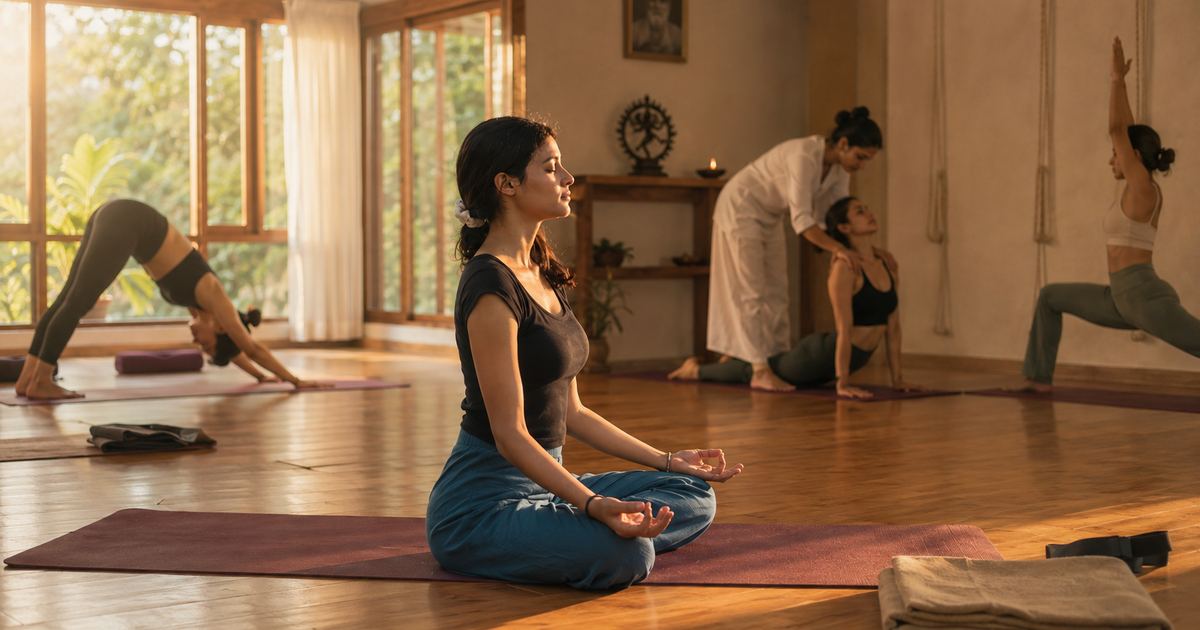
Walk into a Mysore room for the first time and it can be bewildering. Everyone is doing something different. One person is deep in a backbend, another is in the first few breaths of a sun salutation, a third is resting. No one is calling out instructions to the group. A teacher moves quietly from mat to mat, giving a word here, an adjustment there. It looks like disorder, but beneath the surface is a highly structured form of individual instruction within a shared room.
This is Mysore style, named after the southern Indian city where K. Pattabhi Jois taught for decades. It became the characteristic teaching format of Ashtanga within the Jois lineage, and understanding it explains why the practice is learned gradually rather than delivered all at once. It is the traditional teaching format associated with the modern Ashtanga Vinyasa lineage of K. Pattabhi Jois.
How Mysore practice works
In a Mysore class, you practise your own sequence from memory, at your own pace, following your own breath, while the teacher circulates to help individuals. There is no one at the front leading everyone through the same postures at the same time.
You are not left to fend for yourself, though. A beginner usually starts with a short and manageable portion of the practice, often including the sun salutations and a simple finishing section, though the precise starting point varies between teachers and students. As the sequence becomes familiar and stable, further postures are introduced gradually. As the teacher sees greater steadiness in your breath, memory, movement, and overall capacity, the practice may be extended, one posture at a time. Ideally, this progression is a conversation between what the teacher observes and what the practitioner experiences. It is often described as receiving a private lesson inside a group.
The heart of the method is memorisation. Once you know your sequence, you no longer have to look outward to a teacher to know what comes next. Once the order becomes familiar, less attention is spent remembering what comes next, leaving more space for breath, gaze, sensation, and the quality of attention itself. Many lineage-based programmes combine Mysore practice with periodic led classes. Mysore develops memory, personal pacing, and individual guidance, while a led class reinforces the traditional count, breath timing, and collective rhythm.
Why self-practice matters
There is a deeper reason the tradition favours self-practice, and it is worth naming. When you are not following anyone, the practice becomes genuinely yours. You learn to read your own body from the inside, to tell the difference between a day for going deep and a day for going gently through the very same postures. That daily judgment, made without anyone telling you what to do, is a large part of what the practice is actually training.
One of the method's pedagogical strengths is the possibility of individual supervision inside a group setting. A teacher can shorten the practice, adapt a posture, or slow progression according to the student in front of them. This may support safer learning when the teacher is attentive and the practitioner communicates honestly, although Mysore practice has not been shown by research to be inherently safer than other teaching formats.
The rhythm of practice
Within the Jois lineage, the traditional schedule commonly allows for practice on six days of the week, often in the early morning. The exact balance between Mysore and led sessions varies between teachers and schools. Morning practice may be practically convenient because it can be done before eating and before the demands of the day begin, but the most useful time is ultimately the one a practitioner can follow consistently and safely.
That six-day rhythm is best understood as an aspiration rather than an entry requirement. Almost every honest teacher will tell you to start with what you can actually sustain, perhaps two or three mornings a week, and to build from there. For a beginner, consistency is usually more useful than beginning with an unsustainable volume of practice. Repetition in a reasonably stable context can help a behaviour become more automatic over time, though the pace of habit formation varies considerably between individuals.
The tradition also carries some particular customs around rest. There is a weekly rest day, and practitioners traditionally take additional rest on the full and new moon days, the so-called moon days. Within parts of the Jois lineage, women have also been encouraged to rest during the first days of menstruation. This is a lineage convention rather than a universal medical requirement, and individual practitioners may make different choices according to their health, experience, comfort, and professional guidance. These conventions belong to the lineage's own framework and reasoning; they are part of the culture of the practice rather than requirements established by evidence, and a beginner can hold them lightly while finding a rhythm that genuinely supports their life.
Building a practice that lasts
If you want an Ashtanga practice to become part of your life rather than a burst of enthusiasm, a few things help.
Start smaller than you think you should. A short practice you will actually do beats a long one you dread. Practise at the same time each day if you can, because practising in a consistent context, such as at roughly the same time or after the same daily cue, can reduce the amount of fresh decision-making required each day. Learn the sequence properly, ideally with a teacher, so that eventually you can practise without having to think about what comes next; as the sequence becomes familiar, the mental effort of remembering it may lessen, allowing the practice to become more continuous and inwardly attentive. And treat the occasional missed day as ordinary rather than as failure; the practice is a lifelong relationship, not a streak to protect.
Above all, let the practice serve your life rather than the other way around. A sustainable practice bends to fit a real life of work, family, travel, and tiredness, and still, quietly, keeps going.
A note on evidence
This article is mostly about method and discipline rather than physiology, so there is little specific research to report, and I will not manufacture any. There is little research on the Mysore method itself, so claims about its unique psychological or physical effects would be premature. Broader habit research does suggest that repeating a behaviour in a stable context can gradually increase automaticity, while studies of physical-activity habit interventions indicate that consistent cues and repetition may support adherence. Notably, a 2024 systematic review of habit formation found that the time required to form a habit varies widely between behaviours and individuals, which is a useful corrective to the popular idea of a fixed number of days. These findings offer useful background for building a regular practice, but they do not validate the six-day schedule, early-morning practice, moon days, or other lineage-specific conventions.
Closing
The Mysore method is, in a sense, the whole philosophy of Ashtanga made practical: a fixed sequence, learned by heart, practised alone but not unguided, returned to day after day until it becomes less something you do and more a place you go. You do not need a perfect schedule or a heroic commitment to begin. You need a mat, a little protected time returned to regularly, and the willingness to keep beginning again. In the next article we turn to something that frames this daily practice at both ends: the traditional opening and closing mantras, where the physical method meets its older roots.
Before then, if you practise, try setting out your mat at the same hour tomorrow, and simply beginning, however short the practice turns out to be.
References
Lineage and method sources:
MacGregor, K. The Logic of the Six Day a Week Mysore Style Ashtanga Yoga Method. Description of Mysore-style self-practice and the six-day rhythm within the Jois lineage. https://kinoyoga.com/the-logic-of-the-six-day-a-week-mysore-style-ashtanga-yoga-method-by-kino-macgregor/
AshtangaYoga.info. Mysore-style: A Private Lesson in a Group Setting. Description of the self-paced group method and gradual, individualised progression.
Sharath Yoga Centre. Moon Days and Sundays Are Holidays. Statement of the traditional rest-day and moon-day conventions of the lineage.
Peer-reviewed habit research:
Singh, B., Murphy, A., Maher, C., & Smith, A. E. (2024). Time to Form a Habit: A Systematic Review and Meta-Analysis of Health Behaviour Habit Formation and Its Determinants. Healthcare, 12(23), 2488. https://doi.org/10.3390/healthcare12232488
Ma, H., et al. (2023). Effects of habit formation interventions on physical activity habit and behaviour: A systematic review and meta-analysis. International Journal of Behavioral Nutrition and Physical Activity, 20.
Note: This article describes a traditional teaching method and its customs, including the six-day week, weekly rest day, moon days, and menstrual rest. These are conventions of the Ashtanga lineage rather than evidence-based prescriptions. The habit research cited offers general background on consistency and repetition, but does not validate any lineage-specific convention. These summaries reflect sources available at the time of writing.