
Few areas of health are surrounded by as many myths as the mind. Beliefs such as depression being mere weakness, therapy being only for the seriously ill, or children being immune to real distress, are widely held and rarely questioned, yet they are contradicted by decades of evidence. This article examines five of the most common and most harmful myths about mental health and sets each against what research and global health bodies actually tell us. Drawing on data from the World Health Organization, a landmark analysis of psychotherapy outcomes by Smith and Glass, findings on the age of onset of mental illness by Kessler and colleagues, and a review by Dazzi and colleagues on talking about suicide, it shows why these myths persist and what they cost us. Overall, it argues that clearing away myth is not merely an academic exercise but a practical act of care, since accurate understanding is what allows people to seek help without shame.
Keywords: mental health myths, stigma, depression, psychotherapy, help seeking, mental health literacy, wellbeing
Introduction
Fog does not change the road. It only hides it, so that a path we could have walked with confidence suddenly feels dangerous. Myths about mental health work in much the same way. They do not change the truth of what a person is going through, but they hide it behind fear and misunderstanding, and they make the simple act of seeking help feel far harder than it should.
This article is an attempt to clear some of that fog. We will take five of the most common myths about mental health, the kind many of us absorbed without ever choosing to believe them, and hold each one up against the evidence. The goal is not to shame anyone for what they once thought, but to replace fear with facts, so that the path becomes visible again.
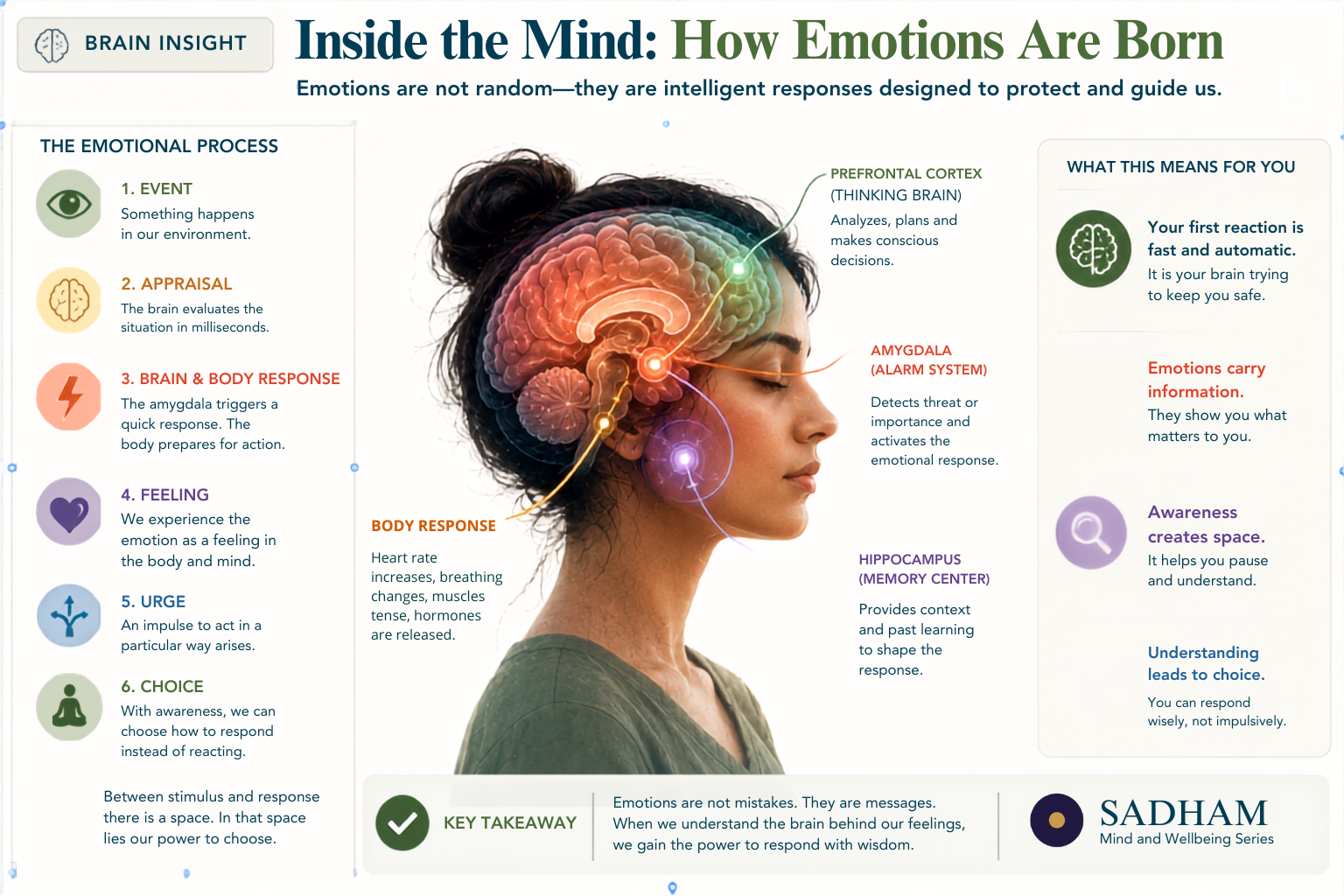
Why myths about the mind are so persistent
Myths about mental health survive for understandable reasons. The mind is invisible, so its struggles are harder to see and easier to misjudge than a broken bone. For generations these topics were wrapped in silence, and silence is the perfect soil for misunderstanding to grow. A myth can also feel strangely comforting, because believing that mental illness only happens to other people, or only to the weak, lets us imagine it could never touch us or those we love. But comfort is not truth. And when myths go unquestioned, they carry a real cost, which is that people who could be helped stay silent, and suffer longer than they ever needed to.
Myth 1: Depression is just weakness
It is common to hear that a depressed person simply needs to try harder, think positively, or toughen up. This belief treats depression as a flaw in character rather than what it actually is. The fact is that depression is a recognised medical condition, not a personal failing. It arises from a combination of factors, including brain chemistry, genetics, physical health and life circumstances, working together. The World Health Organization lists depression among the leading causes of disability in the world, affecting hundreds of millions of people (World Health Organization, 2025). You can no more simply will away clinical depression than you can will away a physical illness. What makes this myth especially harmful is that it adds shame on top of suffering, and that shame is often the very thing that stops someone from reaching out. The hopeful truth is that depression is treatable, and effective help exists.
Myth 2: Therapy is only for people who are seriously ill
Many people imagine that seeing a therapist means something has gone terribly wrong, or that therapy is reserved for those with severe mental illness. This keeps countless people from a resource that could genuinely help them.
In reality, most people who see a therapist are not severely ill at all. They are ordinary people navigating stress, grief, relationship difficulties, self doubt or a hard transition in life. The evidence for therapy is strong and long standing. A landmark analysis by Smith and Glass, which pooled the results of hundreds of studies, found convincing evidence that people who received psychotherapy were better off afterwards than about three quarters of those who did not (Smith & Glass, 1977). Therapy is less like emergency surgery and more like physiotherapy for the mind, a form of skilled support that many kinds of people can benefit from, not only a troubled few.
Myth 3: Children and teenagers do not really struggle
There is a comforting belief that childhood is a carefree time and that young people do not experience real stress, anxiety or depression. It is a myth that can leave a struggling child without help at the very moment they need it most.
The evidence tells a different story. According to the World Health Organization, about half of all mental health conditions begin by the age of fourteen, and three quarters by the mid twenties (World Health Organization, 2024; Kessler et al., 2005). Closer to home, India's National Mental Health Survey found that around seven in every hundred adolescents aged thirteen to seventeen were living with a mental health condition. Dismissing a young person's distress as merely a phase can delay support during the years when early help makes the greatest difference.
Myth 4: Talking about it makes it worse
A deeply held fear is that raising the subject of mental health, and especially of suicide, will somehow plant a harmful idea or make matters worse. Out of this fear, many people stay silent when a caring question could have made all the difference.
The evidence points the other way. A review of the research by Dazzi and colleagues found no evidence that asking someone about suicidal thoughts increases those thoughts, and suggested that open, compassionate conversation may in fact reduce distress and help a person feel less alone (Dazzi et al., 2014). Silence, not conversation, is the greater danger. Asking someone honestly how they are, and being willing to listen without judgement, is one of the most protective things we can do for each other.
Myth 5: Mental illness is rare, and dangerous
Two beliefs often travel together: that mental illness is uncommon, and that those who live with it are to be feared. Both are mistaken, and together they fuel a great deal of unnecessary stigma.
Mental health conditions are not rare. The World Health Organization estimates that in 2021, nearly one in seven people worldwide, more than a billion human beings, were living with a mental disorder (World Health Organization, 2025). Nor are people with mental illness generally dangerous. Research consistently finds that the vast majority are not violent, and that people living with mental health conditions are far more likely to be victims of harm than to cause it. The real harm of this myth lies in the fear and isolation it creates for people who most need understanding.
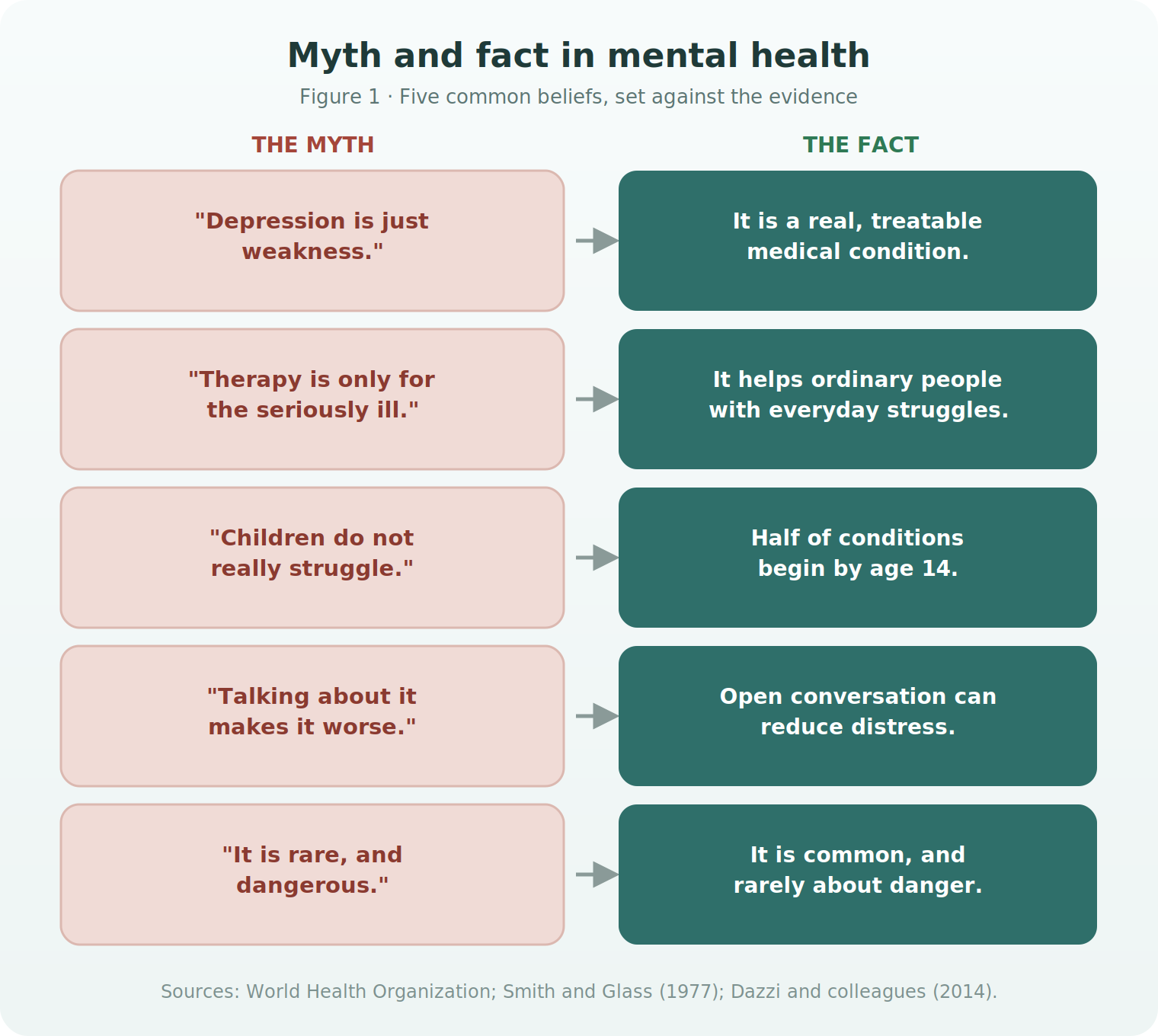
Figure 1. Five common myths, and what the evidence actually says.
Why breaking these myths matters
Clearing away myth is not simply about being correct. It has real consequences for real lives. Because of stigma and misunderstanding, most people who live with a mental health condition never receive the care that could help them (World Health Organization, 2025). Myths turn a treatable condition into a hidden shame, and shame keeps people quiet.
When we replace myth with fact, something shifts. People feel able to seek help earlier. Families support one another more wisely. And a society slowly becomes one in which struggling with your mental health is treated as a human experience to be met with care, rather than a secret to be hidden.
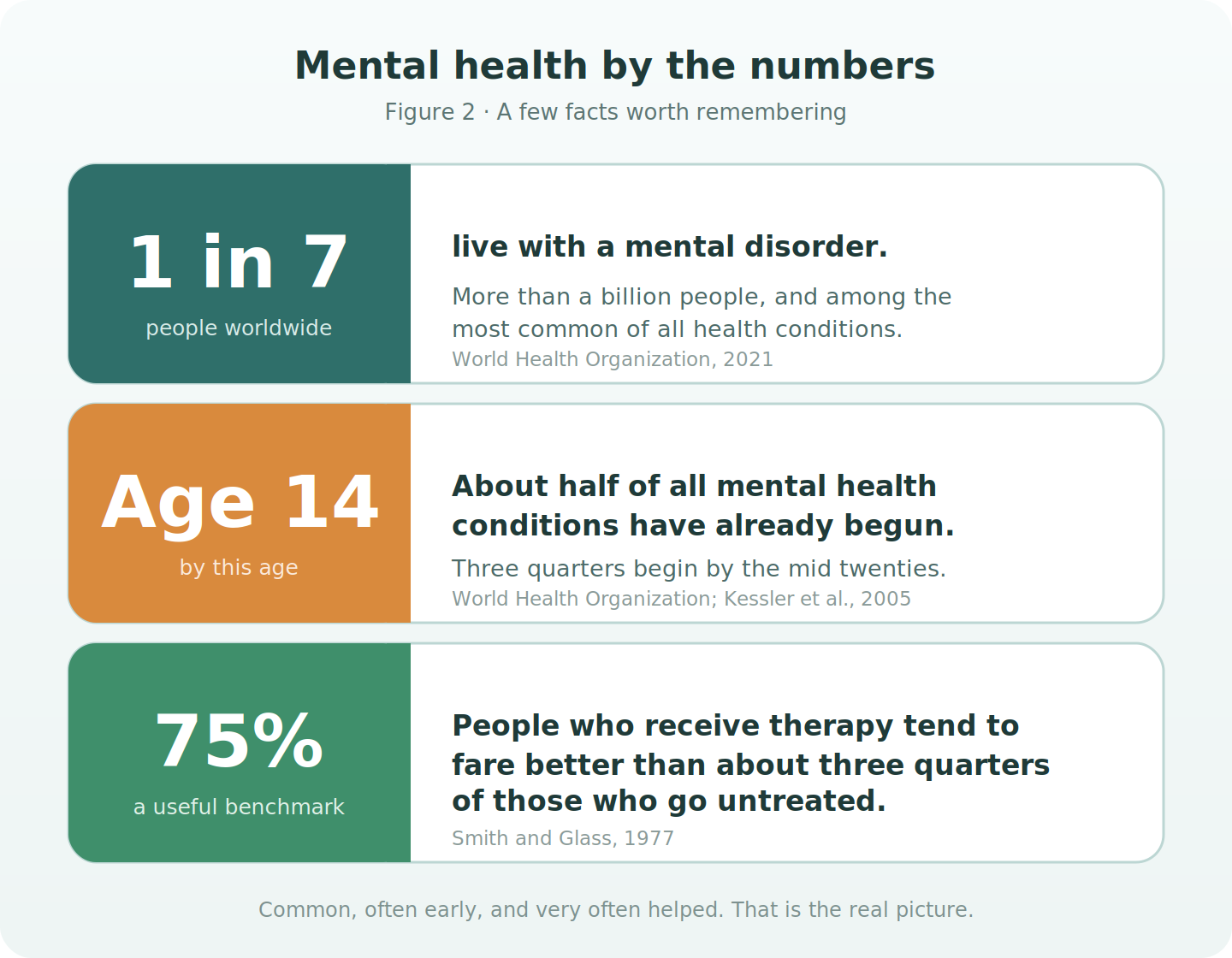
Figure 2. Mental health by the numbers.
When to seek professional support
It is worth reaching out to a qualified mental health professional when difficult feelings persist for weeks and do not ease, when they begin to interfere with sleep, work, studies or relationships, when they feel overwhelming or out of proportion to events, or when you notice any thoughts of harming yourself. It is also worth reaching out if a myth, whether shame, fear or the belief that things are not serious enough, has been the very thing keeping you or someone you love from asking for help.
Seeking support is not a sign that something is wrong with you. It is a sign that you are taking your own wellbeing seriously, which is one of the wisest things a person can do.
The SADHNAM Perspective
If myth is fog, then understanding is light. Alongside evidence based psychology, gentle practices such as honest self reflection, mindful awareness and self compassion can help us meet our own struggles, and those of others, without the extra weight of judgement. At SADHNAM we believe that knowledge and kindness belong together, and that seeing clearly is itself an act of compassion. These practices are meant to complement, and never to replace, professional mental health care when it is needed.
A reflection from the Bhagavad Gita
"Jnanena tu tad ajnanam" (Bhagavad Gita 5.16) This verse is often interpreted to mean that when ignorance is dispelled by knowledge, understanding shines like the sun and reveals what was hidden in darkness. It belongs to a spiritual and philosophical tradition rather than to psychological science, and it does not prove any modern theory. Yet its image of knowledge lifting the darkness of misunderstanding offers a complementary perspective that resonates gently with the aim of this article. Rather than presenting scripture as scientific evidence, we offer it here as a philosophical reflection that may enrich personal understanding.
A Moment of Practice
The two minute SADHNAM exercise. A short practice you will find at the close of every article in this series. This week, a practice in self compassion.
- Sit comfortably and place a hand gently over your heart, feeling its warmth.
- Silently acknowledge the moment as it is: this is hard right now.
- Remind yourself of a simple truth: struggle is part of being human, and I am not alone in it.
- Then offer yourself a few kind words, as you would to a good friend: may I be gentle with myself, may I give myself the understanding I need.
- Take three slow breaths, and let that kindness settle.
This is not about pretending everything is fine. It is about meeting your own difficulty with the same warmth you would offer someone you love, which is often exactly what the myths have taught us to withhold from ourselves.
Key messages
Key Messages
- Depression is a real, treatable medical condition, not a weakness.
- Therapy helps ordinary people with everyday struggles, not only the seriously ill.
- Young people experience genuine mental health difficulties, often beginning early.
- Talking openly, including about suicide, tends to help rather than harm.
- Mental illness is common, and rarely a matter of danger.
- Clearing away myth helps people seek help without shame.
Questions for reflection
Take a quiet moment with these. They are meant not to test you but to help you know your own mind a little better.
- Which of these myths did I once believe, or half believe?
- Has a myth ever stopped me, or someone I care about, from seeking help?
- How do I usually respond when someone shares a mental health struggle with me?
- What is one kinder, more accurate belief I would like to carry forward?
References
Dazzi, T., Gribble, R., Wessely, S., & Fear, N. T. (2014). Does asking about suicide and related behaviours induce suicidal ideation? What is the evidence? Psychological Medicine, 44(16), 3361–3363. https://doi.org/10.1017/S0033291714001299
Kessler, R. C., Berglund, P., Demler, O., Jin, R., Merikangas, K. R., & Walters, E. E. (2005). Lifetime prevalence and age-of-onset distributions of DSM-IV disorders in the National Comorbidity Survey Replication. Archives of General Psychiatry, 62(6), 593–602. https://doi.org/10.1001/archpsyc.62.6.593
Smith, M. L., & Glass, G. V. (1977). Meta-analysis of psychotherapy outcome studies. American Psychologist, 32(9), 752–760.
World Health Organization. (2024). Mental health of adolescents [Fact sheet]. https://www.who.int/news-room/fact-sheets/detail/adolescent-mental-health
World Health Organization. (2025). Mental disorders [Fact sheet]. https://www.who.int/news-room/fact-sheets/detail/mental-disorders
Further reading
For readers who wish to explore mental health facts through trusted public sources:
- World Health Organization, Mental disorders and mental health. https://www.who.int/health-topics/mental-health
- National Institute of Mental Health, Caring for your mental health. https://www.nimh.nih.gov
- National Mental Health Survey of India, NIMHANS. https://nimhans.ac.in
Disclaimer
This article is intended for general educational purposes only. It does not constitute a diagnosis, treatment, or a substitute for professional medical or psychological advice. If your mental health or that of someone you care about is a concern, please consult a qualified mental health professional. For personal guidance shaped around your own situation, you can book a consultation through SADHNAM.
If you are experiencing persistent distress, panic attacks, severe depression, or any thoughts of harming yourself, please seek immediate support from a qualified mental health professional or your local emergency services. You do not have to face it alone.