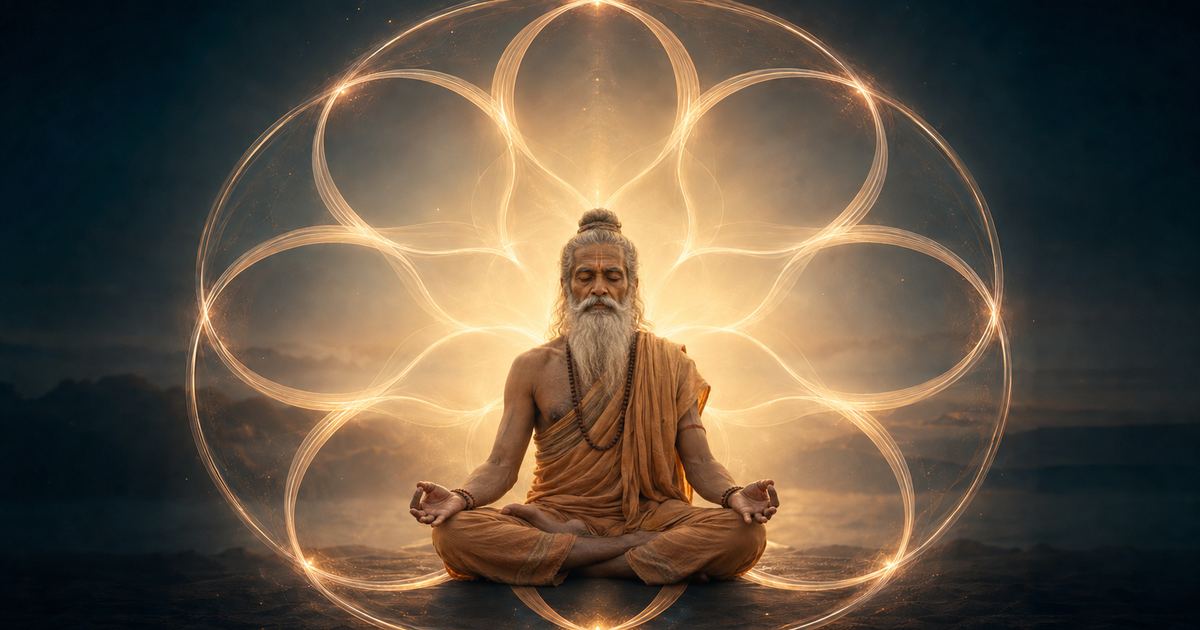
This article opens a ten-part series on the eightfold path of yoga as set down by the sage Patanjali in the Yoga Sutras. Before entering any single limb, it establishes the ground: what Patanjali means by yoga, why the limbs are practised at all, and why the word he chose, anga, carries a meaning quite different from the "step" or "stage" that later translators often assumed. The piece lays out the full map of the eight limbs, divides them into their outer and inner groupings, and prepares the reader for the journey that the remaining articles will walk in detail.
Beginning
There is a certain courtesy owed to an old road. Before we walk it, we might pause and bow to its dust, because that dust holds the footprints of countless people who walked before us. The path of ashtanga yoga is such a road. In the yogic tradition it is understood not merely as an invention, but as a discipline refined through the experience of generations of practitioners, and later gathered into brief, dense aphorisms by the sage Patanjali, who managed to hold an ocean in a cupped palm.
Today we begin the journey. But before we set out, it is worth knowing where the road leads, and what secret that single word, ashtanga, keeps folded inside it.
The Textual Ground
Patanjali opens his work with a word so weighty that whole commentaries have been written on it alone: atha.
Sanskrit (Yoga Sutra 1.1): अथ योगानुशासनम्॥ IAST: atha yogānuśāsanam
Translation: Now, the teaching of yoga begins.
Reflection: This "now" may be read as more than a marker of beginning. It can also suggest the readiness of a mind prepared to turn within, the moment when attention, tired of chasing the world outside, is willing to look inward. On this reading, yoga begins only when that readiness has ripened, not a day before.
In the very next line he defines yoga itself, and the definition is so complete that little needs to be added to it.
Sanskrit (Yoga Sutra 1.2): योगश्चित्तवृत्तिनिरोधः॥ IAST: yogaś citta-vṛtti-nirodhaḥ
Translation: Yoga is the stilling of the fluctuations of consciousness.
Reflection: Here citta is wider than the everyday sense of "mind." It gathers the whole inner field: memory, the sense of "I," the movements of intellect and emotion. Think of it as a lake, and its fluctuations, the vrittis, as ripples on the surface: desires, memories, fears, imaginings. When the ripples settle, the water grows clear enough to show us our own true face. That clarity is yoga. Everything else is the means of reaching it.
The natural question follows. How does one reach that stillness? Here Patanjali introduces the limbs. But first he tells us what their practice actually accomplishes.
Sanskrit (Yoga Sutra 2.28): योगाङ्गानुष्ठानादशुद्धिक्षये ज्ञानदीप्तिराविवेकख्यातेः॥ IAST: yogāṅgānuṣṭhānād aśuddhi-kṣaye jñāna-dīptir ā viveka-khyāteḥ
Translation: Through the practice of the limbs of yoga, impurity dwindles, and a light of knowledge grows until it reaches discriminative discernment.
Reflection: Notice the image the sage reaches for. Wipe the dust from a mirror and the reflection appears on its own; you do not have to manufacture it. In the same way, the practice of the limbs removes what clouds the mind, and the knowledge already resident within begins to shine. Yoga gives us nothing new. It only clears away what was hiding the light.
And now the central verse, the one on which this entire series rests.
Sanskrit (Yoga Sutra 2.29): यमनियमासनप्राणायामप्रत्याहारधारणाध्यानसमाधयोऽष्टावङ्गानि॥ IAST: yama-niyama-āsana-prāṇāyāma-pratyāhāra-dhāraṇā-dhyāna-samādhayo 'ṣṭāv aṅgāni
Translation: Restraint, observance, posture, breath regulation, withdrawal of the senses, concentration, meditation, and absorption. These are the eight limbs.
Reflection: Read the verse closely. Patanjali does not say eight steps. He says eight limbs. That distinction runs deep.
What Anga Really Means
Many translators, especially in the early transmission of yoga to the West, rendered these as the "eight steps," as though one had to be completed before the next could begin. But anga means a limb, a member of a body: an arm, a leg, an eye, a heart. No single limb is the body, and no single limb can be dropped without loss. Together they make one living form, and yoga is that form.
The implication is worth sitting with. One cannot arrive at absorption while ignoring ethical restraint, and yet the practice is not strictly a ladder climbed rung by rung either. Limbs grow together. As restraint deepens, meditation steadies; as meditation steadies, restraint becomes almost effortless. Each nourishes the others.
Even so, the tradition arranged them in an order, because the order traces a real movement, from the outer life toward the innermost stillness.
The Map of the Whole Path
The yogic commentarial tradition commonly understands the first five as the outer limbs and the final three as the inner limbs.
The outer limbs (bahiranga) concern life, body, and breath:
- Yama, how we conduct ourselves toward the world: non-harming, truthfulness, non-stealing, wise regulation of sensual and sexual energy, and non-grasping.
- Niyama, the discipline we keep toward ourselves: purity, contentment, disciplined effort, self-study, and surrender to the divine.
- Asana, a posture that is both steady and at ease.
- Pranayama, the regulation of prana, the living breath.
- Pratyahara, the drawing of the senses back from their objects toward the interior.
The inner limbs (antaranga) unfold within the depths of consciousness:
- Dharana, binding attention to a single point.
- Dhyana, an unbroken, flowing stream of attention toward that point.
- Samadhi, absorption in which the object of meditation alone becomes luminous and the ordinary sense of the meditator recedes.
A note of precision is worth adding here. In relation to the first five limbs, dharana, dhyana, and samadhi are described as the inner limbs. Patanjali later adds that even these remain outer in relation to the highest, seedless absorption, so "inner" is always a matter of relationship, not a final destination.
There is a quiet beauty in the sequence. We begin with our relationship to the world (yama), descend into our relationship with ourselves (niyama), settle the body (asana), then the breath that bridges body and mind (pranayama), then turn the senses inward (pratyahara), and finally rest in the three deepest states of the mind (dharana, dhyana, samadhi). One river, flowing from the coarse toward the subtle, until it becomes the sea.
What the Path Offers
The aim of ashtanga yoga is not merely a supple body or a quiet mind, though both of these arrive as gifts along the way. Its final purpose is viveka-khyati, the discernment that can tell the true from the false, the lasting from the passing, and one's own real nature from the coverings that hide it.
In modern life this becomes only more valuable. We live in an age that pulls the mind outward every waking second, through information, noise, and appetite. Ashtanga yoga is the discipline that slowly draws that outward-running mind back home, and reacquaints it with a stillness that was always present within, merely overlooked.
A Balanced View: Tradition and Modern Research
It is striking that modern research now points toward much of what practitioners had already known through direct experience. A growing body of study on meditation, breath regulation, and attentional training suggests a real and measurable link between mind and body. I will not, in this introductory piece, stake the argument on any single finding, because science is a moving river and its conclusions keep being refined.
In the articles that follow, as we reach the limbs where empirical work is richest, particularly asana, pranayama, and dhyana, each will be accompanied by a fair account of the research currently available. For now it is enough to hold both together. Yogic texts speak through the language of disciplined experience, while science works through systematic evidence. A mature inquiry can respect both without treating them as identical.
Closing Reflection
We have looked at the map today; the walking is still ahead. Remember that Patanjali did not give us eight limbs so that we might tick them off a list, but so that we might live them. None of them is minor, none is optional. On the day you hold steady in non-harming toward another being, you are already in yoga; and on the day you catch a glimpse of absorption, you are in it too.
In the next article we enter the first limb, yama, and see why the purity of our relationship with the world is the ground on which the entire inward journey is built.
Until then, keep in mind that lake within you, the one waiting to grow still.
References
Primary source cited by chapter and verse (pada.sutra):
Patañjali. Yoga Sūtras. Verses cited: 1.1, 1.2, 2.28, 2.29, 3.7 and 3.8.
Secondary literature and translations consulted:
Bryant, E. F. (2009). The Yoga Sūtras of Patañjali: A New Edition, Translation, and Commentary. New York: North Point Press.
Feuerstein, G. (1989). The Yoga-Sūtra of Patañjali: A New Translation and Commentary. Rochester, VT: Inner Traditions.
Iyengar, B. K. S. (1993). Light on the Yoga Sūtras of Patañjali. London: Thorsons.
Taimni, I. K. (1961). The Science of Yoga: The Yoga-Sūtras of Patañjali in Sanskrit. Adyar: Theosophical Publishing House.
Vivekananda, Swami. (1896). Rāja Yoga. New York: Longmans, Green, and Co.
Note on transliteration: Sanskrit terms are given in Devanagari with IAST transliteration alongside. Translations of the verses are the author's own renderings, informed by the commentarial tradition listed above.