
We often imagine that a good relationship is something we stumble upon if only we meet the right person, and that a bad one simply means we chose wrongly. Yet decades of research suggest that the health of our relationships depends far less on who we find and far more on what we build together. This article looks at the psychology of our closest bonds, whether with family, friends, partners or colleagues, and at the skills that hold them together. Drawing on the work of Gottman and Levenson on what predicts a lasting relationship, Holt-Lunstad and colleagues on the link between relationships and health, the Harvard Study of Adult Development, Hazan and Shaver on attachment, and Gable and colleagues on sharing good news, it explores how we communicate, set boundaries, recognise harm, and repair trust. Overall, it argues that strong relationships are less a matter of luck than of learnable skill and steady care.
Keywords: relationships, communication, boundaries, attachment, conflict repair, trust, social connection, wellbeing
Introduction
There is a quiet story many of us carry, which says that love and friendship are things we find. The right partner, the true friend, the perfect team. In this story, a good relationship is a matter of luck, and a difficult one is simply proof that we searched in the wrong place.
The research tells a kinder and more hopeful story. Good relationships are less like treasures we discover and more like gardens we tend. They are built, slowly, through the way we speak and listen, the limits we set, the repairs we make after conflict, and the trust we grow one small moment at a time. This article is about those building blocks, and about how any of us can learn to use them a little better.
Why relationships matter more than we think
Before we look at how relationships work, it is worth pausing on why they are worth the effort. The answer, it turns out, reaches all the way to our health.
In a large review that combined the results of many studies following hundreds of thousands of people, researchers found that people with stronger social relationships had a significantly greater likelihood of survival, and that the influence of connection on how long we live is comparable to well established risks such as smoking (Holt-Lunstad et al., 2010). Relationships are not a luxury laid on top of a healthy life. They are part of its foundation.
The longest running study of human happiness points the same way. The Harvard Study of Adult Development has followed people across more than eight decades, and its central finding is strikingly simple: the people who stay healthiest and happiest into old age are not the richest or the most famous, but those with the warmest relationships (Waldinger & Schulz, 2023). This is true not only of romantic love, but of family ties, friendships and the everyday bonds of work and community.
It is not what you fight about, but how
If relationships matter this much, what actually keeps them strong? One of the most important answers comes from the psychologist John Gottman and his colleague Robert Levenson, who studied couples closely over many years. They found that they could predict which relationships would last, not by whether people argued, since all close pairs do, but by how they argued (Gottman & Levenson, 1992).
Gottman described four especially corrosive habits, sometimes called the four horsemen. The first is criticism, attacking the person rather than naming the problem. The second, and the most damaging of all, is contempt, which is criticism laced with scorn or disrespect. The third is defensiveness, meeting a complaint by warding off all responsibility. The fourth is stonewalling, shutting down and withdrawing entirely. Each of these has a healthier alternative, and learning to swap the habit for its antidote is one of the most useful skills a relationship can have.
Brain Insight: During conflict, the brain tends to shift away from thoughtful problem solving and toward emotional self protection. Pausing before you respond helps re engage the prefrontal cortex, the reasoning part of the brain, which makes calmer and clearer communication far more likely.
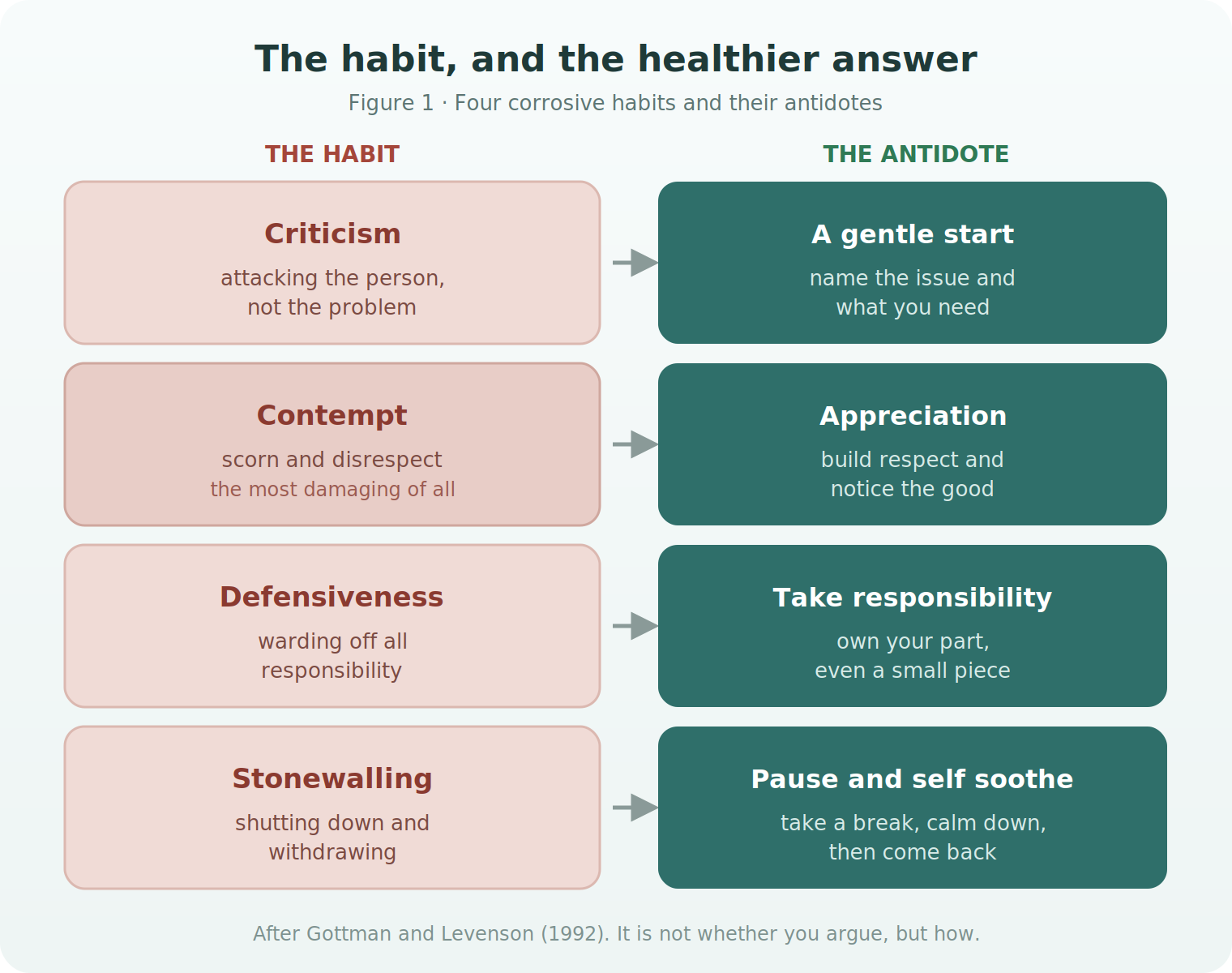
Figure 1. Four damaging habits, and their antidotes (after Gottman and Levenson).
There is a warmer side to this too. Strong relationships are not built only in moments of conflict, but in ordinary moments of connection. Research on what happens when we share good news found that when a partner responds with genuine, active interest, rather than indifference, both the wellbeing of the person and the closeness of the relationship grow (Gable et al., 2004). How we show up when things go right may matter just as much as how we behave when things go wrong.
Boundaries: where you end and another begins
A boundary is often misunderstood as a wall, a way of keeping people out. In truth, a healthy boundary is closer to a clear line that says where you end and another person begins. It protects the relationship as much as the self, because it replaces silent resentment with honest limits.
Setting a boundary can be as simple as saying what you are and are not able to give, declining a request without a long apology, or naming what you need to feel respected. It can feel uncomfortable, especially for those of us taught that saying no is unkind. But a relationship in which no one can ever say no is not truly safe, because agreement that is never freely given cannot be fully trusted.
Our comfort with closeness and limits is shaped early. The psychologists Cindy Hazan and Phillip Shaver extended the idea of attachment, first studied in infants, to adult love, describing broadly secure, anxious and avoidant patterns in how people relate to those they are close to (Hazan & Shaver, 1987). These patterns are not a life sentence. Understanding your own tendencies is often the first step toward relating in a steadier, more secure way.
When a relationship turns harmful
Not every difficult relationship is a harmful one. Conflict, distance and disappointment are part of every close bond. But there is a meaningful difference between a rough patch and a pattern that steadily diminishes you.
Warning signs worth taking seriously include constant criticism or contempt, a sense of walking on eggshells, control over your choices, friendships or finances, a pattern in which your boundaries are always ignored, and a feeling of being drained, small or unsafe over time. In its most serious form, when there is fear, intimidation or any kind of abuse, safety comes first, and reaching out for help is not an overreaction but an act of self respect.
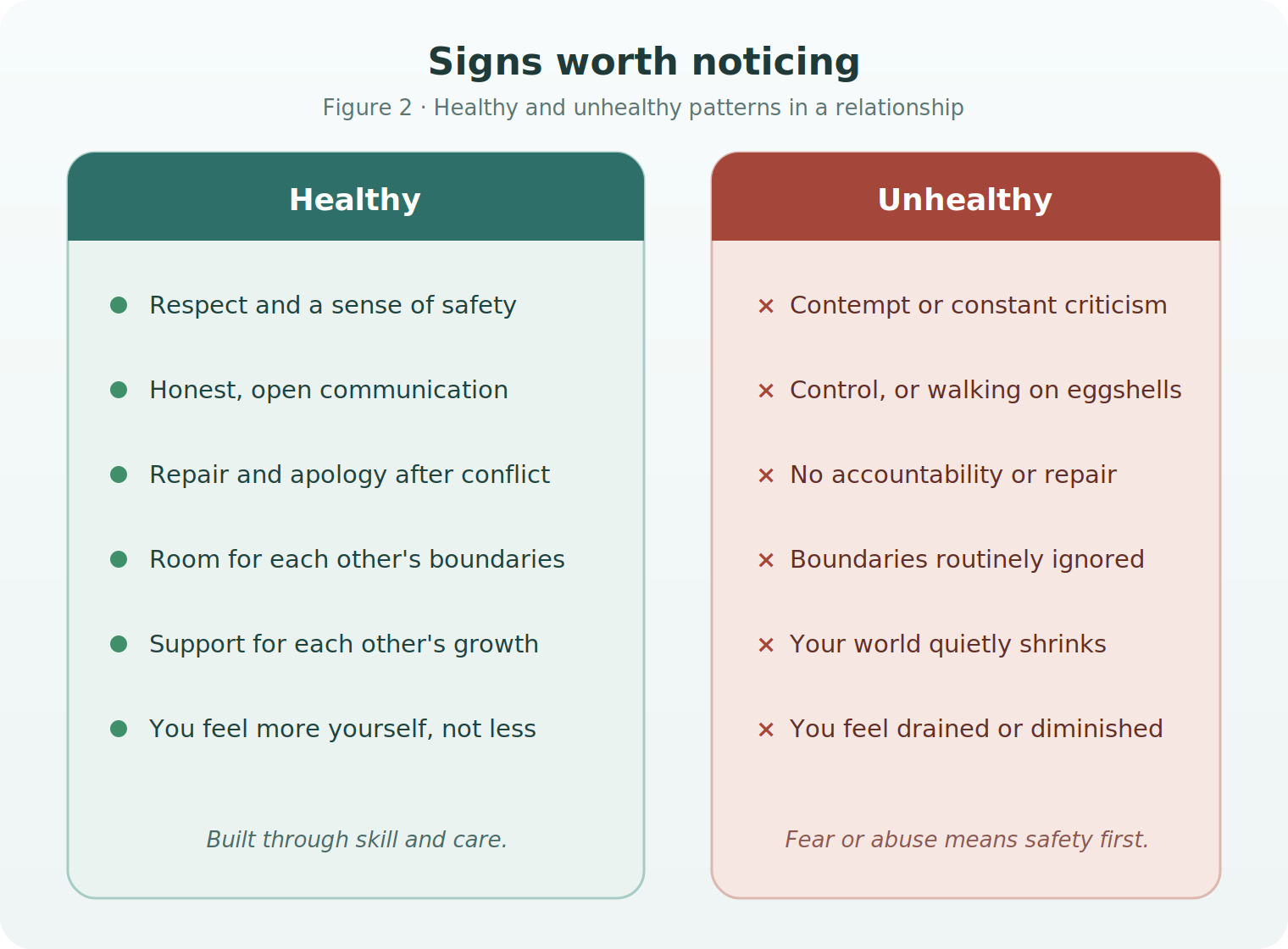
Figure 2. Signs worth noticing, in yourself and in how you are treated.
At a glance: Healthy relationships usually include respect, safety, trust, repair and room for growth. Unhealthy relationships often include fear, control, humiliation, manipulation and isolation.
Rupture, repair and the slow building of trust
Here is one of the most freeing ideas in relationship research: the goal is not a relationship without conflict, which does not exist, but a relationship that knows how to repair. Every close bond experiences small ruptures, a sharp word, a misunderstanding, a moment of distance. What separates strong relationships from fragile ones is the willingness to come back and mend the tear.
Trust is built in much the same way, not in grand gestures but in the accumulation of small, reliable moments. Showing up when you said you would, listening without rushing to fix, remembering what matters to someone, admitting when you were wrong. Each of these is a tiny deposit, and over time they add up to something that can hold real weight.
Forgiveness belongs in this picture too, though it is often misunderstood. To forgive is not to excuse harm or to pretend it did not happen, and it does not always mean staying in a relationship. It is, at heart, the choice to release the grip that resentment holds on you, so that your own peace is no longer chained to another person's actions. Sometimes that release opens the door to repair, and sometimes it simply frees you to move on.
When to seek professional support
It is worth reaching out to a qualified professional, such as a counsellor or therapist, when the same painful patterns repeat no matter how hard you try, when a relationship is affecting your sleep, mood, work or sense of self, when you feel unable to set or keep boundaries, or when conflict regularly leaves you feeling anxious or unsafe. Couple and family therapy exists precisely because relationships are skills, and skills can be learned and strengthened with guidance.
If you ever feel afraid for your safety in a relationship, please treat that seriously and reach out to a trusted person, a professional, or a local support service. You deserve to feel safe in your closest bonds.
The SADHNAM Perspective
Every relationship is, in part, a mirror. The way we meet others often reflects the way we meet ourselves. Alongside evidence based psychology, gentle practices such as mindful listening, self compassion and honest self reflection can help us bring more steadiness and warmth into our connections, so that we respond from care rather than react from old wounds. At SADHNAM we see the tending of relationships as a practice in itself, one that begins with a kinder relationship to our own inner life. These practices are meant to complement, and never to replace, professional support when it is needed.
A reflection from the Bhagavad Gita
"Adveshta sarva-bhutanam maitrah karuna eva cha" (Bhagavad Gita 12.13) This line is often interpreted as describing a person who holds no hatred toward any being, and who is friendly and compassionate by nature. It belongs to a spiritual and philosophical tradition rather than to psychological science, and it does not prove any modern theory. Yet its picture of goodwill and compassion as a way of being offers a complementary perspective that resonates gently with what research tells us about warmth and respect in relationships. Rather than presenting scripture as scientific evidence, we offer it here as a philosophical reflection that may enrich personal understanding.
A Moment of Practice
The two minute SADHNAM exercise. A short practice you will find at the close of every article in this series. This week, a grounding pause for difficult conversations.
- The next time a conversation begins to feel heated, pause before you reply.
- Feel your feet on the floor, and take one slow breath, letting the out breath be long.
- Silently notice three things you can see and two things you can hear, letting your body settle.
- Ask yourself one honest question: in this moment, do I want to win, or do I want to connect?
- Then answer, just a little more slowly and a little more softly than the urge inside you wants.
This small pause interrupts the rush of reaction and gives your wiser, calmer self a chance to speak. Much of the damage in relationships happens in the heat of a single unguarded moment, and this is a way of guarding it with care.
Key messages
Key Messages
- Good relationships are built through skill and care, not simply found.
- Strong social bonds are as important to health as they are to happiness.
- It is not whether you argue, but how, that shapes a relationship's future.
- Boundaries are not walls; they make honest, safe connection possible.
- All close bonds rupture; the key skill is the willingness to repair.
- Persistent harm, fear or feeling unsafe are reasons to seek support.
Questions for reflection
Take a quiet moment with these. They are meant not to test you but to help you know your own relationships a little better.
- Which of my relationships feels most nourishing, and what makes it so?
- Do I tend toward criticism, defensiveness, withdrawal, or something kinder, when conflict arises?
- Where in my life do I most need to set, or honour, a boundary?
- Is there a rupture I could take one small step to repair this week?
References
Gable, S. L., Reis, H. T., Impett, E. A., & Asher, E. R. (2004). What do you do when things go right? The intrapersonal and interpersonal benefits of sharing positive events. Journal of Personality and Social Psychology, 87(2), 228–245. https://doi.org/10.1037/0022-3514.87.2.228
Gottman, J. M., & Levenson, R. W. (1992). Marital processes predictive of later dissolution: Behavior, physiology, and health. Journal of Personality and Social Psychology, 63(2), 221–233. https://doi.org/10.1037/0022-3514.63.2.221
Hazan, C., & Shaver, P. (1987). Romantic love conceptualized as an attachment process. Journal of Personality and Social Psychology, 52(3), 511–524. https://doi.org/10.1037/0022-3514.52.3.511
Holt-Lunstad, J., Smith, T. B., & Layton, J. B. (2010). Social relationships and mortality risk: A meta-analytic review. PLoS Medicine, 7(7), e1000316. https://doi.org/10.1371/journal.pmed.1000316
Waldinger, R. J., & Schulz, M. S. (2023). The good life: Lessons from the world's longest scientific study of happiness. Simon & Schuster.
Further reading
For readers who wish to explore relationships and wellbeing through trusted public sources:
- The Gottman Institute, research on relationships. https://www.gottman.com
- Harvard Study of Adult Development. https://www.adultdevelopmentstudy.org
- World Health Organization, Mental health. https://www.who.int/health-topics/mental-health
Disclaimer
This article is intended for general educational purposes only. It does not constitute a diagnosis, treatment, or a substitute for professional medical or psychological advice. If a relationship is affecting your wellbeing, please consider speaking with a qualified counsellor or therapist. For personal guidance shaped around your own situation, you can book a consultation through SADHNAM.
If you feel unsafe in a relationship, or you are experiencing persistent distress, severe depression, or any thoughts of harming yourself, please seek immediate support from a qualified professional, a trusted person, or your local emergency or support services. You do not have to face it alone.