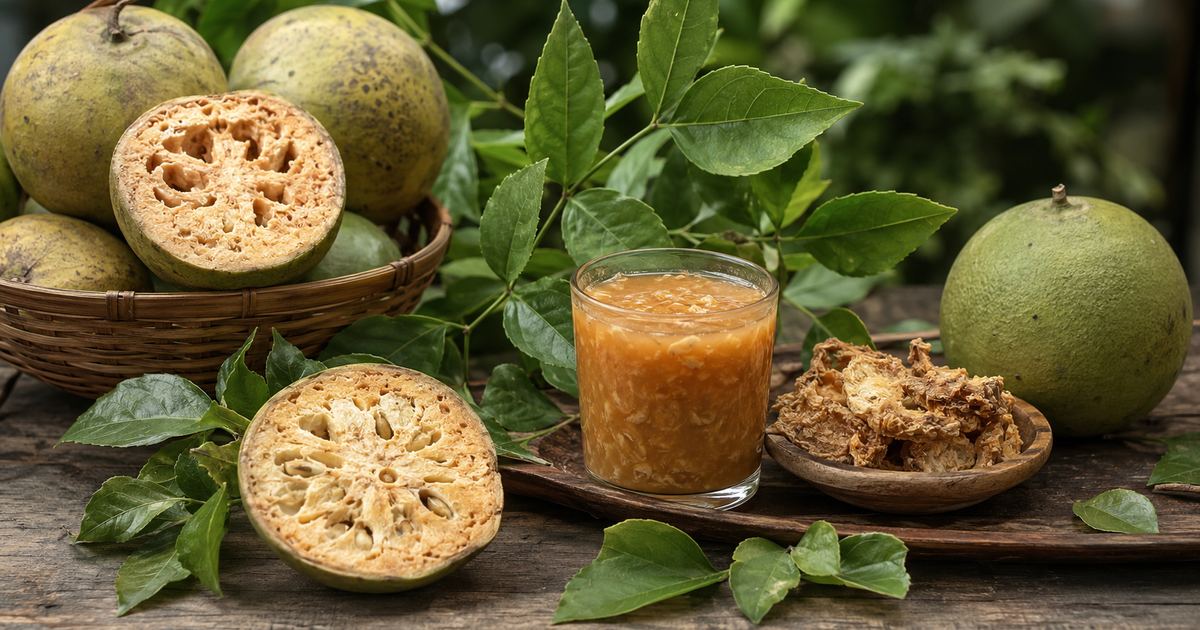
Few plants in the Indian tradition carry the double weight that the bilva does. To the physician it is a dependable astringent for disorders of the gut and one of the pillars of the daśamūla group; to the worshipper of Śiva it is the leaf without which the deity is said to accept nothing. This essay reads the two traditions together and sets them beside what the laboratory has since found. It identifies the tree botanically, examines the classical Ayurvedic account of its fruit, considers its nutritional and phytochemical composition, reviews the modern pharmacological evidence, and notes the cautions that responsible use requires. It then returns to the devotional life of the plant, its bond with the month of Śrāvaṇa, and the rites of its offering. Sanskrit verses are given in the original with IAST transliteration and an English rendering so that the reader may weigh the sources directly.
Keywords: Bilva, Aegle marmelos, śrīphala, grāhi, daśamūla, marmelosin, Śrāvaṇa, bilvapatra
Introduction
There is an old habit in Indian thought of refusing to keep the body and the spirit in separate rooms. The same herb that a vaidya grinds for a stubborn case of dysentery may be the same leaf a pilgrim carries, washed and folded, to lay on a liṅga. The bilva tree is perhaps the clearest example of this refusal. It is at once a medicine of long standing, a fruit of real nutritional worth, and a form of the divine. What follows tries to hold all three together, giving the classical texts their voice, the modern studies their say, and the ritual its due.
Botanical profile
Bilva is Aegle marmelos (L.) Corrêa, a medium-sized deciduous tree belonging to the citrus family Rutaceae. It is slow-growing and hardy, enduring dry, difficult soils where softer trees fail. Its branches carry sharp spines. The leaves are alternate and aromatic, usually trifoliate though sometimes bearing up to five leaflets, each leaflet ovate, pointed, and shallowly toothed. The flowers are small, greenish white, and sweetly scented, gathered in loose clusters on the young wood. The fruit is round to oval with a hard woody rind, grey green while unripe and turning yellowish as it matures, and it gives off a characteristic pleasant smell. Within lies an orange, sweet, resinous pulp studded with many seeds set in mucilage. The tree is native to India and is found across South and Southeast Asia, from the sub-Himalayan tract through the plains into the drier forests of the peninsula.
Bilva in Ayurveda
The standing of bilva in medicine rests first on its root, which opens the bṛhat pañcamūla, the five greater roots of the daśamūla, standing before agnimantha, śyonāka, gambhārī, and pāṭalā. A decoction of the ten roots is still among the most prescribed of formulations for its work against vāta, swelling, and fever.
On the fruit, the classical texts insist on one distinction above all, that between the ripe and the unripe. Vāgbhaṭa puts it plainly in the Aṣṭāṅgahṛdaya, in the chapter on the nature of foods:
पक्वं सुदुर्जरं बिल्वं दोषलं पूतिमारुतम्। दीपनं कफवातघ्नं बालं ग्राह्युभयं च तत्॥
IAST: pakvaṁ sudurjaraṁ bilvaṁ doṣalaṁ pūtimārutam, dīpanaṁ kaphavātaghnaṁ bālaṁ grāhy ubhayaṁ ca tat.
The ripe bilva, he says, is heavy and hard to digest, it disturbs the doṣas, and it leaves a foul wind behind it. The tender, unripe fruit does the opposite: it kindles the digestive fire and settles kapha and vāta, and both states of the fruit share the grāhi quality, the power to bind and absorb. A student who remembers only one line about bilva should remember this one, for it corrects the common error of eating the sweet ripe pulp for a complaint that in truth calls for the unripe fruit.
In the language of dravyaguṇa, the unripe fruit is astringent and bitter in taste, light and dry in quality, hot in potency, and pungent after digestion, and it pacifies kapha and vāta. Both Caraka and Suśruta count it among the finest of the saṅgrāhi substances, those that check flux by drawing off excess fluid and firming the stool. Cakradatta later recommended it in chronic dysentery, loose motions, and piles, while Bhāvaprakāśa and Baṅgasena treated it as a leading remedy for the diseases of the intestines.
Traditional uses
Almost every part of the tree has been put to use, which is why the tradition calls it a complete tree of medicine. The unripe fruit, dried into the pulp known as belagiri, is the classic remedy for atisāra, pravāhikā, and grahaṇī, that is, diarrhoea, dysentery, and the group of chronic bowel disorders. The ripe pulp, taken as a cooling drink or sharbat, is valued in the hot months as a mild laxative and a soother of thirst and of a burning stomach. The leaf, pressed for its fresh juice, has a long reputation in the management of prameha or diabetes, and also appears in remedies for fever and for eye complaints. The root belongs to the daśamūla and carries its vāta-quieting action, while the bark and the aromatic rind have been used for digestive and febrile conditions. Beyond Ayurveda, the same applications recur in Unani and in village practice across the subcontinent, most consistently for the stomach and the bowel.
Nutrition
The ripe pulp is a genuinely nourishing food, not merely a medicine. Reported figures vary with cultivar, ripeness, and the method of analysis, but the broad picture from Indian food-composition data and published studies is steady. Roughly sixty percent of the fresh pulp is water. Carbohydrate is the dominant nutrient, in the region of thirty grams per hundred grams, which places the energy value near the higher end for a fresh fruit, commonly cited between about ninety and one hundred and forty kilocalories per hundred grams depending on the source. Protein sits near two grams and fat below half a gram. There is useful dietary fibre, close to three grams, much of it in the form of pectin and mucilage, the soluble, gel-forming fibres that account for the fruit's soothing, bulk-giving effect on the gut.
Among the micronutrients, bael is best known for riboflavin, vitamin B2, which it carries in a quantity unusual among fruits, alongside thiamine and niacin. It supplies vitamin C, with reported values ranging widely from single figures up to around sixty milligrams per hundred grams in fresh pulp, and it contributes beta-carotene as a precursor of vitamin A. The fruit also provides useful amounts of potassium, calcium, and phosphorus, along with smaller amounts of iron and copper. Taken together, this makes the ripe fruit a worthwhile source of energy, soluble fibre, and antioxidants during the season when it is eaten.
Modern scientific evidence
Contemporary research has taken an active interest in bilva, and much of what it reports lines up with the classical picture rather than against it. The plant is chemically rich. Its most studied phytochemicals include coumarins such as marmelosin, imperatorin, marmin, umbelliferone, and psoralen, together with the alkaloid aegeline, tannins, flavonoids, terpenoids, and essential oils. The tannins are worth singling out, since their astringency is the plausible chemical basis for the very grāhi action the texts describe.
The most direct validation of tradition concerns the gut. Experimental studies of the unripe fruit have demonstrated antidiarrhoeal activity and have identified possible effects on microbial adherence, invasion, and enterotoxin action. These findings lend scientific support to its traditional use, although they do not yet constitute definitive clinical proof. Alongside this, extracts of the fruit and leaf show gastroprotective and anti-ulcer activity in experimental models, with the coumarin marmin implicated in protecting the stomach lining.
A second large body of work addresses blood sugar. Leaf extracts inhibit the digestive enzymes alpha-amylase and alpha-glucosidase, which would slow the release of glucose from a meal, and they lower blood glucose in diabetic animals; a smaller number of clinical reports point the same way. To these are added consistent findings of antioxidant and anti-inflammatory activity, and, in preclinical settings, antimicrobial, antifungal, antiviral, hepatoprotective, cardioprotective, radioprotective, and anticancer effects.
Two honest qualifications belong here. Most of this evidence comes from laboratory assays and animal experiments; well-designed human trials remain few, and the doses, extracts, and plant parts differ from study to study. So while the direction of the findings is encouraging and often agrees with centuries of use, it is not yet the same thing as clinical proof for any specific treatment. Taken together, these investigations provide a plausible biochemical explanation for many of the therapeutic actions described in the classical Ayurvedic literature, while also highlighting the need for larger clinical trials.
Safety
As a food, ripe bael is well tolerated and has a long record of ordinary use. A few sensible cautions still apply. Because the fruit is astringent and firming, taking it in large amounts, especially the unripe fruit or its preparations, can bind the bowel and produce constipation or a sense of heaviness, which is exactly the disturbance Vāgbhaṭa attributed to the ripe fruit eaten to excess. People who are prone to constipation or who have weak digestion and a vāta tendency should be moderate.
Since experimental studies suggest that bilva leaf preparations may lower blood glucose, people taking antidiabetic medication should use medicinal preparations only under professional supervision. Reliable evidence concerning medicinal doses during pregnancy and breastfeeding remains insufficient. These cautions do not detract from the ripe fruit as an ordinary food; they simply distinguish dietary consumption from therapeutic dosing.
The bond with Śrāvaṇa
The tie between bilva and the monsoon month of Śrāvaṇa is usually explained through the churning of the ocean. The old accounts place that churning in Śrāvaṇa and remember that the first thing to rise from the sea was not nectar but the poison hālāhala, whose heat threatened to burn the three worlds. Śiva gathered it and held it in his throat, which darkened, and from that he took the name Nīlakaṇṭha, the blue-throated one. Tradition holds that offerings such as water, milk, and bilva leaves symbolically soothe the heat borne by Śiva after he consumed the hālāhala.
A reader of the Ayurvedic texts will notice a quieter reason as well. Śrāvaṇa falls in the rains, the season when the digestive fire is at its lowest, when vāta is easily provoked, and when the very bowel disorders discussed above arrive in force. The remedy the season asks for is precisely a substance that warms digestion, binds the bowel, and calms vāta and kapha, which is to say bilva. The bilva offered to Śiva in Śrāvaṇa belongs to the same tree whose unripe fruit Ayurveda particularly values during the rains for its grāhi, dīpana, and vāta-kapha hara actions. The ritual and medical traditions thus converge upon the same plant, though they employ different parts of it for different purposes.
Bilva in the Purāṇas and Śaiva worship
In the Purāṇic imagination the tree is not merely dear to Śiva but a form of him, and the Śiva Purāṇa holds that when nothing else is at hand, a single bilva leaf completes the worship. The threefold leaf invites reading, and the Bilvāṣṭaka attributed to Ādi Śaṅkarācārya offers the best known:
त्रिदलं त्रिगुणाकारं त्रिनेत्रं च त्रयायुधम्। त्रिजन्मपापसंहारम् एकबिल्वं शिवार्पणम्॥
IAST: tridalaṁ triguṇākāraṁ trinetraṁ ca trayāyudham, trijanma-pāpa-saṁhāram eka-bilvaṁ śivārpaṇam.
Three-leaved, shaped after the three guṇas, an emblem of the three eyes and the three weapons of Śiva, and a destroyer of the sins of three births, this one bilva leaf is offered to Śiva. The same hymn reads the single leaf as the whole trinity, Brahmā at the stalk, Viṣṇu in the middle, Śiva at the tip:
मूलतो ब्रह्मरूपाय मध्यतो विष्णुरूपिणे। अग्रतः शिवरूपाय एकबिल्वं शिवार्पणम्॥
IAST: mūlato brahma-rūpāya madhyato viṣṇu-rūpiṇe, agrataḥ śiva-rūpāya eka-bilvaṁ śivārpaṇam.
Two familiar narratives account for the leaf's power, and they can be told briefly. The first, attached to the night of Śivarātri, concerns a hunter who took shelter in a bilva tree above a forgotten liṅga. Having eaten nothing since dawn he had fasted without meaning to; staying awake he kept the vigil; and as the branches stirred, dewy leaves dropped onto the stone below, so that even the offering was made in ignorance. Moved through the night to spare the lives of deer that pleaded with him, the hardened man was softened, and for all of this, done unknowingly yet truly, Śiva granted him at the end the highest state. The lesson is that a single leaf laid down with a clean heart outweighs a lifetime of wrong.
The second kind of narrative concerns the tree's origin, and every version binds it to the goddess of fortune. In the telling of the Bṛhaddharma Purāṇa, the bilva grew from a part of Lakṣmī herself, offered to Śiva in the extremity of her devotion; the Agni Purāṇa traces it instead to the cow of the sage Bhṛgu and says that from the tree arose Śrī, which is why the fruit is called śrīphala. The connection is marked in a verse of offering:
लक्ष्म्याः स्तनत उत्पन्नं महादेवस्य च प्रियम्। बिल्ववृक्षं प्रयच्छामि एकबिल्वं शिवार्पणम्॥
IAST: lakṣmyāḥ stanata utpannaṁ mahādevasya ca priyam, bilva-vṛkṣaṁ prayacchāmi eka-bilvaṁ śivārpaṇam.
Sprung from Lakṣmī and dear to Mahādeva, this bilva tree I present, and a single leaf of it I offer to Śiva. Older than either Purāṇa, the Śrī Sūkta already speaks of a bilva born of the goddess's austerity:
आदित्यवर्णे तपसोऽधिजातो वनस्पतिस्तव वृक्षोऽथ बिल्वः। तस्य फलानि तपसा नुदन्तु या अन्तरा याश्च बाह्या अलक्ष्मीः॥
IAST: āditya-varṇe tapaso'dhijāto vanaspatis tava vṛkṣo'tha bilvaḥ, tasya phalāni tapasā nudantu yā antarā yāś ca bāhyā alakṣmīḥ.
O goddess bright as the sun, from your austerity arose this best of trees, the bilva; may its fruits drive off every misfortune, the poverty within us and the poverty that presses from without. Read together, these verses explain why one tree can be dear at once to Lakṣmī and to Śiva.
The manner of offering
The devotional literature is exact about how the leaf is given, and the exactness is part of the devotion. The verse of offering may be the tridalaṁ triguṇākāram, or the words the Liṅga Purāṇa places in Śiva's own mouth:
मणिमुक्ताप्रवालैस्तु रत्नैरप्यर्चनं कृतम्। न गृह्णामि बिना देवि बिल्वपत्रैर्वरानने॥
IAST: maṇi-muktā-pravālais tu ratnair apy arcanaṁ kṛtam, na gṛhṇāmi binā devi bilva-patrair varānane.
Worship made with gems and pearls and coral and every jewel, he tells the goddess, I do not accept, O fair one, if it comes without bilva leaves. Those who cannot manage a verse may offer the leaf with the five syllables oṁ namaḥ śivāya, or with the name of Śiva simply spoken, for the purity of the feeling is what is asked.
The leaf itself should be whole and soft and unbroken, of three lobes, and free of holes. Two blemishes are avoided, the cakra, a whitish patch on the surface, and the vajra, the knot on the stalk. The leaf is washed clean and laid face downward, its smooth upper surface toward the liṅga. Number carries weight, and on the great days, on Śivarātri, on the Mondays of Śrāvaṇa, on Pradoṣa, a worshipper may offer eleven, twenty-one, thirty-one, one hundred and eight, or a thousand and eight leaves; yet the literature that counts so carefully insists that one leaf given in devotion is enough. The plucking has its own courtesy, made with a spoken request recorded in the Ācārendu:
अमृतोद्भव श्रीवृक्ष महादेवप्रियः सदा। गृह्णामि तव पत्राणि शिवपूजार्थमादरात्॥
IAST: amṛtodbhava śrī-vṛkṣa mahādeva-priyaḥ sadā, gṛhṇāmi tava patrāṇi śiva-pūjārtham ādarāt.
O auspicious tree born of nectar, ever dear to Mahādeva, with reverence I take your leaves for the worship of Śiva. There are days on which the leaf is not plucked, the fourth, eighth, ninth, and fourteenth of the fortnight, the new moon, the moment of saṅkrānti, and Monday; on these one offers a leaf taken the day before. The tradition adds a gentle relief, holding that bilva leaves never go stale or become impure, so that a leaf already offered may be washed and offered again.
Bilva at a glance
| AttributeDetail | |
| Botanical name | Aegle marmelos (L.) Corrêa, family Rutaceae |
| Sanskrit names | Bilva, śrīphala, śāṇḍilya, śailūṣa, mālūra, sadāphala, śivadruma |
| Parts used | Unripe fruit and dried pulp (belagiri), leaf, root, bark, ripe pulp |
| Rasa, guṇa, vīrya, vipāka | Astringent and bitter; light and dry; hot potency; pungent after digestion |
| Doṣa action | Pacifies kapha and vāta |
| Cardinal action | Grāhi or saṅgrāhi, that is, absorbent and bowel-binding |
| Classical uses | Diarrhoea, dysentery, chronic bowel disorders, and as part of daśamūla |
| Key phytochemicals | Coumarins including marmelosin, imperatorin, marmin, umbelliferone, and psoralen; aegeline, tannins, and flavonoids |
| Notable nutrients | Carbohydrate, soluble fibre (pectin and mucilage), riboflavin, vitamin C, potassium |
| Modern evidence | Antidiarrhoeal and gastroprotective, antidiabetic, antioxidant and anti-inflammatory, mostly preclinical |
| Main caution | Excess can constipate; may lower blood sugar; limited safety data in pregnancy |
| Ritual role | Foremost offering to Śiva; three lobes read as guṇas, eyes, and trinity |
| Auspicious time | Śrāvaṇa, its Mondays, and Śivarātri |
Closing
To hold the accounts of bilva side by side is to see something about the mind that produced them. The physician values the unripe fruit for binding a loose gut and the root for quieting the wind in the body; the food scientist finds soluble fibre, riboflavin, and potassium in the ripe pulp; the pharmacologist isolates coumarins and tannins and watches them settle the bowel and lower blood sugar; and the Purāṇas value the leaf as a form of the three gods, born of Lakṣmī, dearer to Śiva than any jewel. These are not rival claims about the tree but four readings of one plant. It is fitting that the season which most needs the medicine of bilva is also the season that most heaps its leaves upon Śiva, as though the rains, the healing, and the worship were all keeping a single time.
References and further reading
The article draws on the classical sources and on representative modern studies listed below. Readers who wish to consult the verses in context are directed to standard editions of the texts.
Classical sources
- Aṣṭāṅgahṛdaya of Vāgbhaṭa, Sūtrasthāna, chapter on the nature of foods, verse on bilva.
- Caraka Saṁhitā and Suśruta Saṁhitā, on the saṅgrāhi property of bilva and on the bṛhat pañcamūla of the daśamūla.
- Bhāvaprakāśa Nighaṇṭu, synonyms and properties of bilva.
- Cakradatta and Baṅgasena, on the use of bilva in dysentery, diarrhoea, and piles.
- Śiva Purāṇa, on the glory of bilva and the account of the hunter.
- Liṅga Purāṇa, on the verse of offering and the days on which the leaf is not plucked.
- Skanda Purāṇa, on the re-offering of a washed leaf.
- Bṛhaddharma Purāṇa and Agni Purāṇa, on the origin of the tree.
- Bilvāṣṭaka attributed to Ādi Śaṅkarācārya.
- Śrī Sūkta, the verse on the bilva born of the goddess's austerity.
- Ācārendu, the invocation spoken while plucking the leaf.
Representative modern studies
- Brijesh S., Daswani P., Tetali P., Antia N., and Birdi T., "Studies on the antidiarrhoeal activity of Aegle marmelos unripe fruit: validating its traditional usage," BMC Complementary and Alternative Medicine, 2009, volume 9, article 47.
- Bhar K., Mondal S., and Suresh P., "An Eye-Catching Review of Aegle marmelos L. (Golden Apple)," Pharmacognosy Journal, 2019, 11(2), 207-224.
Standard reference works and compendia
- Kirtikar K.R. and Basu B.D., Indian Medicinal Plants, on the description, distribution, and traditional uses of Aegle marmelos.
- The Ayurvedic Pharmacopoeia of India, Ministry of AYUSH, Government of India, official monograph on Bilva (fruit and root), covering identity, properties, and indications.
- Indian Food Composition Tables, National Institute of Nutrition, Indian Council of Medical Research (ICMR–NIN), for the proximate and micronutrient values of bael.
Note: several of the Purāṇic narratives survive in variant forms across different texts, and the most widely received tradition has been presented here. Reported nutritional and pharmacological figures vary with cultivar, ripeness, extract, and method. Medicinal use of the plant should be undertaken only on the advice of a qualified physician.