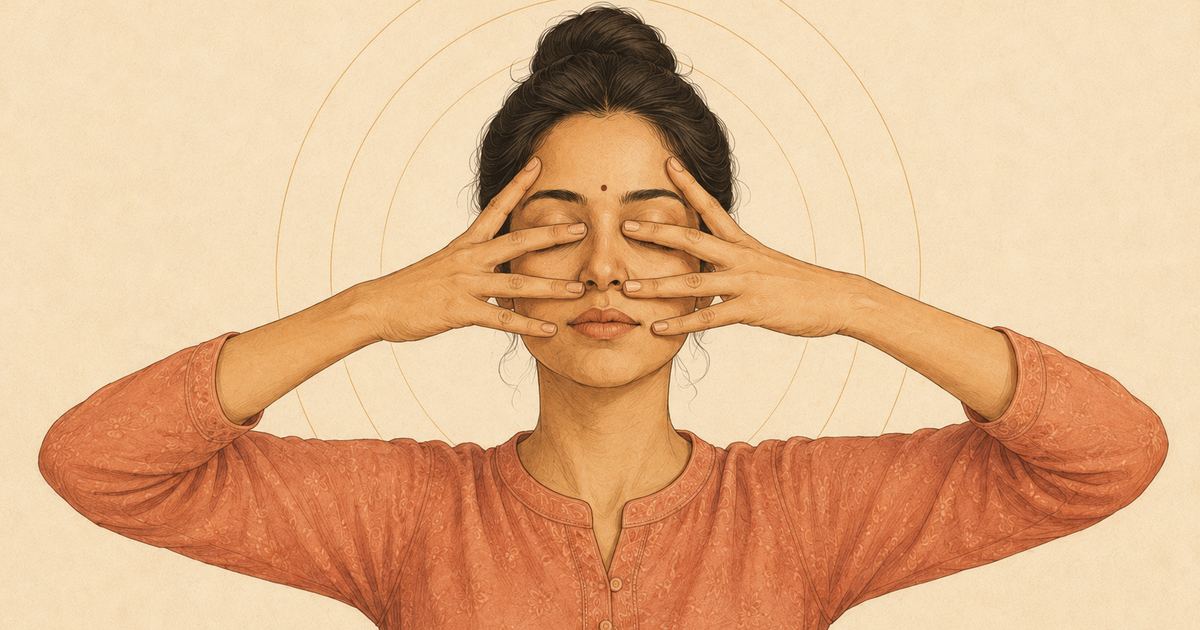
Bhramari pranayama is often introduced simply as a technique to calm the mind, but its roots run much deeper. It is a classical breathing practice described in influential texts of the Hatha Yoga tradition.
The name comes from the Sanskrit word bhramar, meaning a black bee. During the practice, the exhale carries a gentle humming sound produced during nasal exhalation, much like the drone of a bee. This is why it is often called the humming bee breath, or simply bee breath, in English.
Its real value lies less in the sound itself and more in the vibration and inner quiet that the practitioner feels. In the yogic tradition it was never treated only as a breathing exercise. It was seen as a doorway to nada, the awareness of inner sound.
How the Texts Describe Bhramari
Bhramari is counted among the eight retentions, or ashta kumbhaka, that appear in the classical Hatha Yoga texts. The Hatha Yoga Pradipika (2.44) lists these eight as Suryabhedana, Ujjayi, Sitkari, Shitali, Bhastrika, Bhramari, Murccha, and Plavini.
1. Hatha Yoga Pradipika (Chapter 2, Verse 68)
Swatmarama's Hatha Yoga Pradipika provides one of the best known classical descriptions in its second chapter:
अथ भ्रामरी। वेगाद्घोषं पूरकं भृङ्गनादं भृङ्गीनादं रेचकं मन्दमन्दम्। योगीन्द्राणामेवमभ्यासयोगाच्चित्ते जाता काचिदानन्दलीला॥६८॥
IAST: atha bhrāmarī | vegādghoṣaṃ pūrakaṃ bhṛṅganādaṃ bhṛṅgīnādaṃ recakaṃ mandamandam | yogīndrāṇām evam abhyāsayogāc citte jātā kācid ānandalīlā || 68 ||
Meaning: Inhale quickly with a resonant sound like that of a male bee, then exhale very slowly with a sound like that of a female bee. Through this practice, an indescribable feeling of bliss arises in the mind of the yogi.
One detail here is worth noticing. The original verse mentions a sound during the inhale as well, whereas most modern practice keeps the humming only on the exhale.
2. Gheranda Samhita (Chapter 5, Verses 78 to 82)
The Gheranda Samhita treats Bhramari with far more depth, presenting it as a sound based practice that leads toward samadhi:
अथ भ्रामरीकुम्भकः। अर्धरात्रे गते योगी जन्तूनां शब्दवर्जिते। कर्णौ पिधाय हस्ताभ्यां कुर्यात्पूरककुम्भकम्॥७८॥
IAST: atha bhrāmarīkumbhakaḥ | ardharātre gate yogī jantūnāṃ śabdavarjite | karṇau pidhāya hastābhyāṃ kuryāt pūrakakumbhakam || 78 ||
Meaning: After midnight, in a place free of the sounds of living creatures, the yogi should close both ears with the hands and perform inhalation and retention.
The following verses (5.79 to 5.82) explain that with steady practice the practitioner begins to hear a series of inner sounds in the right ear. First something like crickets, then a lute, thunder, a drum, a bee, bells, and a conch. In the end comes the anahata nada, the unstruck sound that rises from the heart and carries the yogi toward samadhi.
This method resembles practices now commonly taught with Shanmukhi Mudra, although the precise hand position varies across traditions. It serves as a preparation for nadanusandhana, the inner search for sound. Texts such as the Shiva Samhita also describe the first sound heard in nada yoga as the hum of a bee.
The two descriptions at a glance
| AspectHatha Yoga Pradipika (2.68)Gheranda Samhita (5.78 to 82) | ||
| Main emphasis | Bee like sound and a feeling of bliss | Inner sound (nada) and samadhi |
| Ears | Not mentioned | Closed with the hands |
| Timing | General | After midnight, in full silence |
| Goal | Bliss in the mind | Anahata nada, then samadhi |
How to Practise Bhramari
What follows is a safe, simplified version suited to beginners.
Sit in any comfortable meditation posture, such as sukhasana or siddhasana. A chair is perfectly fine too. Keep the spine long, let the shoulders soften, and gently close the eyes.
Breathe in slowly and deeply through both nostrils. As you breathe out, keep the mouth closed and exhale gently through the nose while producing a soft, steady "mmmm" sound, without tightening the throat. Keep it long and even, gentle rather than loud or forced. Let your attention rest on the vibration and notice how it spreads through the head, the face, the teeth, and the space between the eyebrows.
For a deeper version, you can add shanmukhi mudra by pressing the small flap of cartilage at each ear (the tragus) lightly with the thumbs, resting the other fingers on the face, and listening to the sound within. Press only gently, never hard.
Begin with about five rounds and increase gradually as your comfort grows.
A note from research: a small physiological study observed greater nasal nitric oxide output at approximately 130 Hz than at the other frequencies tested. This finding should not be treated as a fixed therapeutic pitch, and practitioners should simply use a comfortable, unforced tone.
Beginners do not need to force breath retention, or kumbhaka. Never strain the breath.
When to Practise, and When to Eat
Early morning on an empty stomach is the best time for Bhramari. It also works well in the evening, especially when the mind feels restless. Doing it before meditation, or at the close of a yoga session, is particularly helpful because it settles the mind for concentration. The deeper, sound based version of the Gheranda Samhita was traditionally kept for the quiet hours of the night, though that belongs to advanced practitioners.
Like all pranayama, Bhramari is done on an empty or light stomach. As a practical guide, leave at least three to four hours after a heavy meal, and about two hours after a light snack. A full stomach makes the practice uncomfortable and restricts the movement of the diaphragm.
On the traditional side, the Hatha Yoga Pradipika (1.58) sets out the principle of mitahara, a moderate diet. The food should be balanced, wholesome, easy to digest, slightly unctuous, and neither too hot nor aggravating to the body. The old measure was to fill half the stomach with food, a quarter with water, and to leave a quarter empty. The text recommends milk and ghee as suitable during the early stage of practice (2.14), while very sour, salty, pungent, and overly heating foods are discouraged.
The Possible Benefits
Effects described in the tradition
In the traditional view, Bhramari brings a feeling of bliss and calm to the mind, as the Hatha Yoga Pradipika describes, and it opens awareness of inner sound and the anahata nada, as the Gheranda Samhita explains. It also prepares the mind for meditation and concentration.
Possible effects observed in early research
Preliminary studies suggest that regular and correct practice may help reduce stress, anxiety, and mental restlessness, may shift the nervous system toward the parasympathetic, or relaxation, state, and may support sleep, focus, and a sense of physical calm. These findings come mostly from small studies and should be read as early signals rather than proven outcomes.
What the Research Says
Over the past two decades, several studies have looked at Bhramari and at humming in general. The main findings are summarised below in plain language. Much of this work rests on small samples and still needs further confirmation, so it is best read as promising rather than settled.
Nitric oxide and sinus health. A well known study from the Karolinska Institute in Sweden by Weitzberg and Lundberg (2002) found that humming raises nitric oxide in the nasal passages by roughly fifteen times, because the vibration improves air exchange between the sinuses and the nose. Nitric oxide plays a role in relaxing blood vessels and in fighting microbes. A later study (Maniscalco and colleagues, 2003) reported that a lower frequency hum of around 130 Hz produced the most nitric oxide. This mechanism has led researchers to investigate Bhramari as a supportive practice in chronic rhinosinusitis. Preliminary clinical findings are encouraging, but the evidence is not yet sufficient to establish it as a treatment.
Lung and respiratory function. In a randomised controlled trial by Mooventhan and Khode (2014, International Journal of Yoga), participants who practised a combined programme of Bhramari and OM chanting for two weeks showed improvements in selected pulmonary function measures, including peak expiratory flow, forced expiratory flow, and maximal voluntary ventilation. Because both practices were used together, the effect cannot be attributed to Bhramari alone.
Heart, blood pressure, and nervous balance. Pramanik and colleagues (2010, Nepal Medical College Journal) recorded a drop in heart rate and blood pressure immediately after Bhramari. A randomised trial in patients with high blood pressure by Yadav and colleagues (2023, Journal of Ayurveda and Integrative Medicine) found that both Nadi Shodhana and Bhramari improved sympathovagal balance and produced a clear reduction in auditory reaction time, indicating faster responses to auditory stimuli under the conditions of the study. Studies on heart rate variability point in the same direction, toward parasympathetic, or relaxation, dominance.
Brain waves. An exploratory EEG study involving eight practitioners (Vialatte and colleagues, 2009, Consciousness and Cognition) observed unusual high frequency gamma activity during Bhramari. The study identified a distinctive brain activity pattern, but it did not establish improvements in memory, attention, or cognition.
Tinnitus. In work by Pandey and colleagues (2010) and others, Bhramari has been linked to better quality of life in people with tinnitus, along with reduced tinnitus related sadness, anxiety, and distress. The proposed mechanisms remain uncertain and require further investigation.
Mental health and sleep. A study on COVID-19 patients in home isolation (2022, Journal of Ayurveda and Integrative Medicine) found that fifteen days of Bhramari practice produced a clear reduction in depression, anxiety, and stress on the DASS-21 scale, with improvements in sleep and overall quality of life.
Reviews. Broader reviews by Kuppusamy and colleagues (2018, Journal of Traditional and Complementary Medicine) and in the Indian Journal of Physiology and Pharmacology (2024) reported encouraging findings across psychological, cardiovascular, and pulmonary outcomes, while also noting that stronger and better designed studies are needed.
Where Research Has Looked
Current research has explored Bhramari in relation to stress, blood pressure, sleep, tinnitus, respiratory function, and chronic rhinosinusitis. The evidence remains preliminary, and Bhramari should be used only as a complementary practice, not as a replacement for medical care.
Who Should Take Care
Anyone with a serious ear problem, such as an active ear infection, ear pain, or recent ear surgery, should check with a doctor or a qualified yoga therapist first, and in particular avoid the version that closes the ears.
If you feel dizzy, uncomfortable, or notice pressure in the head during practice, stop at once and return to normal breathing.
People with serious heart disease, uncontrolled blood pressure, epilepsy, or those who are pregnant should practise only under proper guidance.
Do not force breath retention. Beginners can simply focus on the humming without any kumbhaka. It is worth remembering that the Hatha Yoga Pradipika itself (2.16 to 2.17) warns that pranayama done wrongly can cause harm, which is exactly why good guidance matters.
Closing Thoughts
Bhramari pranayama sits at an interesting meeting point. The Hatha Yoga Pradipika calls it a practice that stirs bliss in the mind, the Gheranda Samhita treats it as a path toward the anahata nada and samadhi, and modern research is beginning to examine its possible role in stress regulation, blood pressure, sleep, sinus health, and tinnitus.
Its strength is its simplicity. A few minutes of gentle humming, practised in a quiet and appropriate setting, can become a simple preparation for meditation. And its beauty, in the end, lies not in the sound but in the vibration and the stillness the practitioner feels within.
References
Classical texts
- Hatha Yoga Pradipika by Swatmarama. Chapter 2, verse 44 (the eight kumbhakas) and verse 68 (Bhramari); Chapter 1, verse 58 (mitahara); Chapter 2, verse 14 (diet).
- Gheranda Samhita by sage Gheranda. Chapter 5, verses 78 to 82 (Bhramari kumbhaka and anahata nada). Translations referenced: James Mallinson (2004); Srisa Chandra Vasu (1914 to 1915).
- Shiva Samhita, on the bee sound in nada yoga (referenced).
Modern research
- Weitzberg E, Lundberg JON. "Humming Greatly Increases Nasal Nitric Oxide." Am J Respir Crit Care Med. 2002;166(2):144 to 145.
- Maniscalco M, Weitzberg E, Sundberg J, Sofia M, Lundberg JO. "Assessment of nasal and sinus nitric oxide output using single-breath humming exhalations." Eur Respir J. 2003;22(2):323 to 329.
- Mooventhan A, Khode V. "Effect of Bhramari pranayama and OM chanting on pulmonary function in healthy individuals: A prospective randomized control trial." Int J Yoga. 2014;7(2):104 to 110.
- Pramanik T, Pudasaini B, Prajapati R. "Immediate effect of a slow pace breathing exercise Bhramari pranayama on blood pressure and heart rate." Nepal Med Coll J. 2010;12(3):154 to 157.
- Vialatte FB, Bakardjian H, Prasad R, Cichocki A. "EEG paroxysmal gamma waves during Bhramari Pranayama: A yoga breathing technique." Conscious Cogn. 2009;18(4):977 to 988.
- Yadav S, et al. "Effects of Nadishodhana and Bhramari Pranayama on heart rate variability, auditory reaction time, and blood pressure: A randomized clinical trial in hypertensive patients." J Ayurveda Integr Med. 2023;14(4):100774.
- Pandey S, Mahato NK, Navale R. "Role of self-induced sound therapy: Bhramari pranayama in tinnitus." Audiol Med. 2010;8:137 to 141.
- "Bhramari Pranayama intervention on stress, anxiety, depression and sleep quality among COVID-19 patients in home isolation." J Ayurveda Integr Med. 2022;13(3):100596.
- Kuppusamy M, et al. "Effects of Bhramari Pranayama on health: A systematic review." J Tradit Complement Med. 2018;8(1):11 to 16.
- "Exploring the health benefits of Bhramari pranayama (humming bee breathing): A comprehensive literature review." Indian J Physiol Pharmacol. 2024.
- Abishek K, et al. "The Efficacy of Yogic Breathing Exercise Bhramari Pranayama in Relieving Symptoms of Chronic Rhinosinusitis." Int J Yoga. 2019;12(2):120 to 123.
Disclaimer: This article is for education and general information. Bhramari is a complementary practice, not a substitute for medical treatment. If you have a health condition, consult a qualified doctor or trained yoga therapist before beginning.