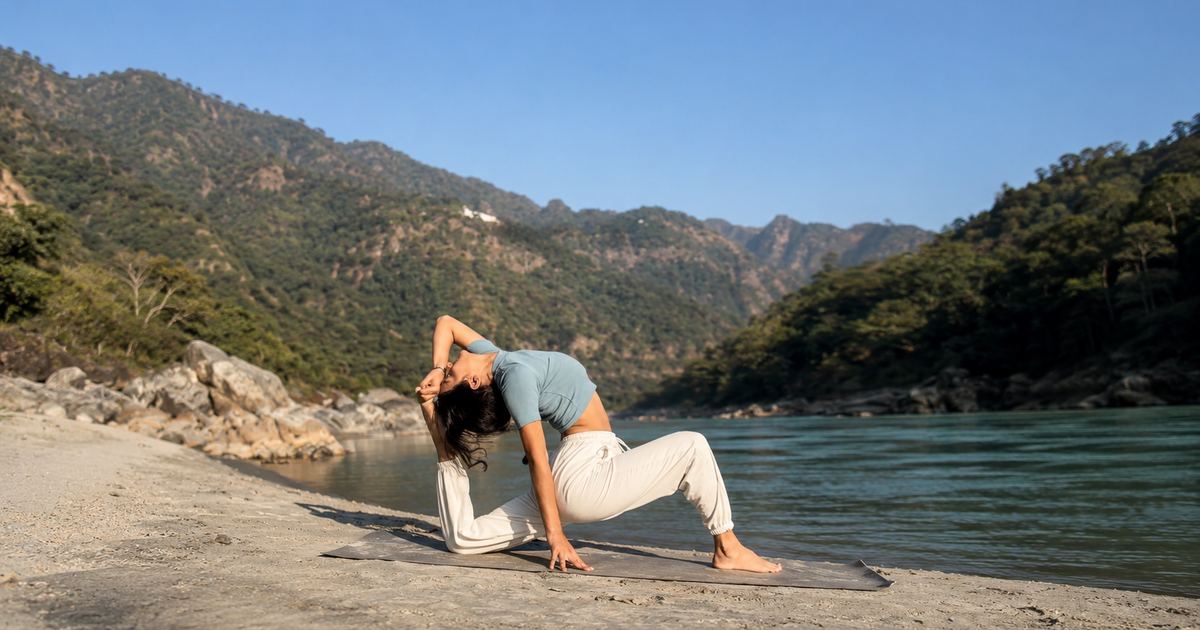
This final article draws the series together. Rather than introducing new material, it gathers the threads of the previous nine articles: the breath, the gaze, the bandhas, the sun salutations, the set sequences, the Mysore method, and the mantras, bringing them into a practical picture of how to sustain an Ashtanga practice over a lifetime. Its concern is how to practise safely and sustainably while remaining honest about what the method can and cannot promise.
Looking back over the path
We began this series by clearing up what Ashtanga Vinyasa actually is: a dynamic, breath-led method shaped in the modern Mysore tradition. It is historically distinct from Patanjali's eightfold path, although the two are often placed in philosophical conversation with one another. From there we took the practice apart, one element at a time.
We met tristhana, the three points of attention, and saw how coordinating posture, breath, and gaze can make movement more continuous, concentrated, and inwardly attentive. We looked closely at the breath, the thread that leads every movement, and at the bandhas, the subtle internal engagements used within the method to organise movement, breath, and attention. We put those elements back together in the sun salutations, then followed them into the Primary Series, the Intermediate Series, and the question of when, or whether, to move on. We looked at the Mysore method and the discipline of a regular practice, and finally at the mantras that frame the whole thing. If you have followed the series this far, you now have a fairly complete map of the practice.
This closing article is about how to walk it without hurting yourself, and without losing heart.
What the practice honestly offers
Across these articles I have tried to be careful about evidence, and it is worth gathering that honesty in one place.
The clearest evidence comes from yoga research more broadly, rather than from direct study of the complete Ashtanga method. Yoga interventions can improve some measures of flexibility, balance, mobility, strength, and physical function, depending on the population and style studied. A small number of Ashtanga-based studies also point toward selected physical benefits, but direct research on the traditional sequences remains too limited for broad, method-specific conclusions. The physical structure of Ashtanga clearly challenges strength, mobility, flexibility, and endurance; how large or lasting those adaptations are will vary between practitioners and has not yet been measured adequately across the full method.
The breath-focused elements sit beside a substantial body of research on voluntary slow breathing, including a large meta-analysis of 223 studies reporting increases in vagally-mediated heart-rate variability during and after controlled breathing practice. That evidence is relevant background, but it cannot be transferred directly to the audible, breath-linked respiration used during vigorous Ashtanga movement. The effects on mood and wellbeing are plausible and widely reported, and supported by broad yoga research using mostly gentler styles, but not established for Ashtanga specifically.
The more traditional claims, the purification of the body in the Primary Series, the cleansing of the nadis in the Intermediate, the energetic language of the bandhas and the mantras, belong to the tradition's own framework. They are meaningful as lived experience and as a way of understanding the practice from within, but they should not be presented as established physiological mechanisms unless direct evidence supports such a translation. Holding them as what they are is more respectful of both science and tradition.
None of this is a reason to practise less wholeheartedly. It is a reason to practise with clear eyes.
The principles that keep a practice safe
If there is a single practical thread running through this series, it is that patience generally supports progress, while force and poorly managed progression increase unnecessary risk. A few principles gather everything the earlier articles said about staying uninjured.
Let the breath guide your pacing. If it becomes suddenly ragged, repeatedly held, or difficult to recover, take that as a practical cue to reduce the intensity, modify the posture, or pause. The breath is not a medical diagnostic tool, but it can be a useful sign that the present effort is no longer sustainable. Respect your body, the structure of the sequence, and an appropriate pace of progression. Postures are introduced one at a time, when the ground is ready, and there is no prize for skipping ahead. Distinguish ordinary muscular effort from pain that is new, sharp, escalating, persistent, associated with swelling or instability, or that repeatedly returns in the same place. No single sensation can diagnose an injury, but pain should be treated as information rather than as a test of commitment; stop or modify when necessary, and seek qualified assessment when symptoms persist or affect normal movement. Learn with a skilled and attentive teacher where possible, since individual observation can help with pacing, modification, and progression in ways a general video cannot; but teaching does not remove all risk, and communication, consent around physical adjustments, and your own feedback remain essential. And know your own body, particularly if you are pregnant, injured, or managing any concern with your wrists, shoulders, back, neck, hips, or heart, in which case the practice should be shaped to you, with professional guidance where it matters.
Making it last
A safe practice and a sustainable one turn out to be the same practice. A practice intended to last for decades cannot be built only on intensity. It needs a form that can be repeated, recovered from, and adapted as the practitioner's body and life change. Sustainability is not a lesser version of discipline; it is what allows discipline to continue.
So start smaller than your enthusiasm suggests. Build consistency before volume and depth. Let the fixed sequence become familiar enough that it carries you rather than demands to be figured out each day. Allow adequate recovery, and use the rest days built into the lineage as one possible framework rather than as a universal biological prescription; additional rest may be necessary during illness, injury, major fatigue, pregnancy, or periods of unusual physical and emotional demand. And let the practice serve your life, bending to fit work, family, travel, illness, and age, rather than becoming one more demand that eventually breaks. A practice that adapts is a practice that survives.
Above all, hold it lightly. Ashtanga can become unusually rigid in the wrong hands, a source of self-judgment and quiet competition. The antidote is to remember what the closing mantra says at the end of every practice: the aim is not a deeper posture, but a steadiness that can wish the whole world well.
Where the two series meet
This series has described the body: breath, movement, engagement, sequence, discipline. Its companion series, written in another voice, describes the inner path Patanjali laid out: restraint, observance, and the long turning of attention inward toward stillness. They are distinct approaches that can illuminate one another: one beginning with embodied repetition, the other with an explicit philosophical map of conduct, attention, and stillness.
For some practitioners, sustained physical practice becomes one way of exploring concerns that also appear in Patanjali's philosophy: discipline, attention, habit, reactivity, and the possibility of greater inner steadiness. That connection is interpretive and experiential, not a scientific conclusion or an automatic result of performing the sequence. It is an invitation to find out for yourself, carefully, over years.
Closing
Thank you for walking this series. If you take only a few things from it, let them be these: let the breath lead, respect your body and an appropriate pace of progression, learn with a good teacher, hold the tradition's claims with both warmth and honesty, and let the practice serve your life rather than rule it. Done that way, Ashtanga need not remain a young person's athletic feat. It can become a lifelong companion, a place to return to on good days and difficult ones alike.
Roll out your mat, begin with the breath, and let the rest come in its own time.
The end of the series.
References
This closing article synthesises material developed across the series. For the evidence on slow breathing, see Article 3; for sun salutations and physical outcomes, Article 5; for Ashtanga-specific therapeutic claims and injury literature, Articles 6 and 7; and for consistency, habit formation, and practice rhythm, Article 8. No new series-specific effectiveness claim is introduced here.
The meta-analysis of voluntary slow breathing cited above: Laborde, S., et al. (2022). Effects of voluntary slow breathing on heart rate and heart rate variability: A systematic review and a meta-analysis. Neuroscience & Biobehavioral Reviews, 138, 104711. https://doi.org/10.1016/j.neubiorev.2022.104711
Note: The broader yoga literature provides useful context for physical function, breathing, mood, and safety, but direct research on the complete Ashtanga sequences remains limited. Traditional energetic and therapeutic language has therefore been presented within its own philosophical and experiential framework rather than translated automatically into biomedical fact. These summaries reflect sources available at the time of writing.